
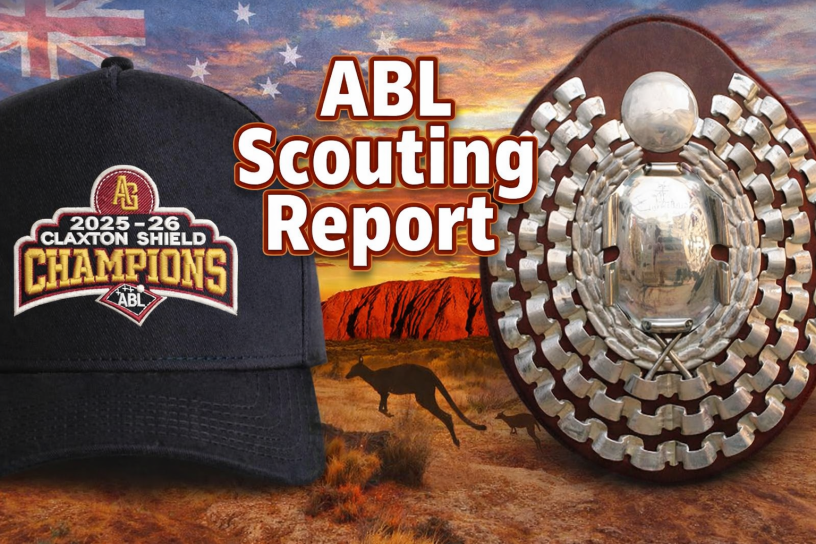
The Adelaide Giants won their third Australian Baseball League championship in four years recently. The team featured eight Phillies prospects on the roster for the Winter League season. We’ll take a look at those prospects.
Born in Porlamar, Venezuela, Giussepe Velasquez was signed as an international free agent by the Philadelphia Phillies on July 2, 2019 when he was 16 years old.
Velasquez began his professional career in the Phillies’ Dominican Summer League (DSL) and throughout his early minor league innings he showed promising strikeout ability. In 2021 with DSL Phillies White he made 14 starts, threw 52.1 innings, struck out 56, walked 19, and posted a solid 2.75 ERA. That early performance drew attention for his ability to miss bats even as a teenager.
His development was interrupted by Tommy John surgery, which caused him to miss almost two full seasons of competitive innings. Returning mid‑2025 after rehab, he pitched in the Florida Complex League (FCL) and then at Class-A Clearwater. In the FCL he was very effective in a small sample with a 0.54 ERA, a very low WHIP, and strong strikeout numbers, but at Clearwater he struggled more when stretched out as a starter with a 6.42 ERA and a higher walk rate. Over the 2025 season in the minors he logged a combined 52.1 innings with 41 strikeouts but also showed control issues which are to be expected for pitchers coming off of TJS; just ask Andrew Painter. On the year he finished with a 1‑4 record and a 6.42 ERA in his eight starts at Clearwater. Across his minor league career from 2021 to 2025 he has a 4.00 ERA over 155 innings with 157 strikeouts and a 1.30 WHIP.
Pitch Arsenal, Velocity, and Usage
Velasquez, a right‑hander, has an athletic, repeatable delivery and is generally considered a pitcher who relies on mixing pitches rather than dominating with pure velocity. His fastball sits in the low‑90s, typically around 90–93 mph, which is solid but not overpowering for a professional starter. Scouts note that he mixes that fastball with several secondary offerings including a slider, a changeup, and occasionally a cutter or sinker depending on the report. During his rehab and in earlier scouting he showed plus spin on his breaking pitches and good movement on off‑speed pitches. He’s valued more for his ability to spot these pitches and change speeds than for how they blow hitters away.
He uses the fastball to establish the zone, the slider as a put‑away pitch to righties, and the changeup to keep opposite‑handed hitters off balance. The cutter or sinker type pitch seems to be more of a complementary offering that he uses occasionally to induce weak contact or ground balls.
Scouting Strengths and Weaknesses
A key strength for Velasquez is his instincts and “pitchability.” Even as a young pitcher he was described as a strike‑thrower who mixes his pitches well and hits his spots rather than overpowering hitters. Coming out of the DSL, his ability to command a four‑pitch mix was notable for his age, and he’s still seen as having the makings of a starter rather than strictly a reliever because he can keep hitters off balance over multiple at‑bats in an outing.
On the downside, his velocity is average, and without plus heat he needs to get swings and misses with his secondary pitches. After returning from Tommy John surgery, his walks spiked slightly and his ERA suffered at Class A, showing that after a long layoff there is still polish needed in his command and consistency. In the minor leagues he has been around a 1.30 WHIP for his career, which isn’t bad, but the uptick in walks and runs in his higher level outings indicates that refining the command of his secondary pitches will be key for his future.
Injuries and How They’ve Affected Him
The most significant interruption in Velasquez’s development was the TJS that cost him nearly two seasons of competition. That surgery typically requires a year or more of recovery, and while he returned in 2025 and showed flashes of effectiveness, it’s fair to say that missing those development years slowed his polishing of command and game endurance. Coming back from such a major procedure can impact arm strength, durability, and confidence in certain pitchers.
Sabermetric Context and Projection
From the available minor league scouting reports, his strikeout rate has been respectable but not elite, and after he returned from surgery his effectiveness varied between levels. A 1.30 career WHIP in the minors suggests he can limit baserunners fairly well when he’s locating, but his 6.42 ERA at Clearwater in 2025 shows that he still has work to do, especially in sequencing his pitches and reducing free passes. Scouts often describe him as a pitcher who knows how to pitch and competes well, but will need more refined command and a little more velocity or sharper break on his secondaries to be a reliable starter in the upper levels.
Outlook
At 22 going on 23, Velasquez has a chance to establish himself at Class A or higher in the Phillies system if he continues to refine his control and pitch mix. He’s not a prospect with a big fastball or huge strikeout numbers, but his feel for pitching and willingness to mix pitches has remained consistent even after a long injury layoff. If he can cut down on walks and keep hitters off balance deeper into games, he will stick as a starter long term, but he if not, his niche will be as a multi‑inning reliever if his repertoire plays better in shorter bursts.
Please scroll down to comment on this story or to give it a rating. We appreciate your feedback!

Disclaimer: Some of the products featured or linked on this website may generate income for Philly Baseball News through affiliate commissions, sponsorships, or direct sales. We only promote items we believe in, but please assume that PBN may earn a cut from qualifying purchases that you make using a link on this site.
Privacy Policy | Contact us
© 2025 LV Sports Media. All rights reserved.

 phillybaseball.news