
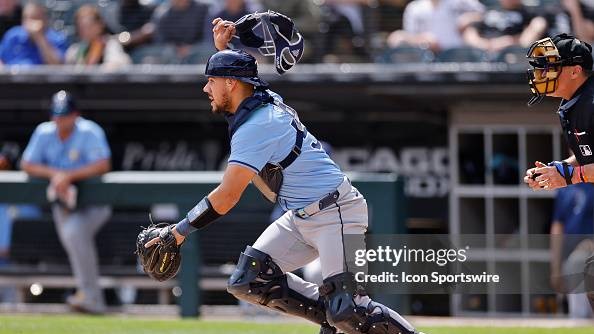
Rene Pinto is a right-handed hitting catcher from Maracay, Venezuela. Pinto signed with the Tampa Bay Rays as an international amateur free agent in 2013.
Pinto’s calling card as a young catcher was defense first, bat second. In the Venezuelan Summer League in 2015, the Rays’ player bio notes he threw out 47.9% of attempted base stealers (23 of 48), which is an eye-popping number even allowing for the level and sample size.
Offensively, he was a steady climber more than a can’t-miss prospect. His stat line bounced around as he moved levels, but the shape of the player came into view: some contact ability, and more pull-side pop than you’d guess at first glance. The big breakout power year was 2021, when he split time between Double-A Montgomery and Triple-A Durham and hit .274/.325/.500 with 20 homers. That season is a big reason the Rays added him to the 40-man roster that November rather than risk losing him in the Rule 5 Draft.
In other words, his defense and developing offense were enough to keep moving through the Rays system. Even with the spurt of power though he has always been seen in a backup role, rather than ever being treated like a future everyday starting catcher.
Major league snapshot and results
Pinto debuted in April 2022 and as if he was trying to show he was more of a power hitter than scouts thought, his first MLB hit was a home run. From 2022 through 2024, he appeared in 83 MLB games and hit .231/.263/.404 with 10 home runs.
The year-to-year version of that story matters. In 2023, he hit for noticeably more power in his limited run with six homers in 105 plate appearances. While 2024 was a smaller sample with only 49 plate appearances, he had a similar slugging look but not much overall impact.
Offense: what tends to work, and what tends to get him
Pinto’s offensive value is basically tied to whether the power shows up, because the on-base piece has been light in the majors. His MLB on-base percentage across those three seasons sits at .263, which means he doesn’t have much margin for error when the homers are not coming.
Statcast’s “run value” breakdown is a nice way to describe the vibe without getting too deep in the weeds. Across his MLB time, his overall batting run value is slightly negative, and most of the drag shows up on pitches on or near the edges of the zone. That tracks with the eye test you’d expect from a power-first backup type: when he’s right, he does damage on mistakes he can pull, but he’s not consistently winning a bunch of tough pitches on the margins.
One quick way to see the swing in his quality of contact is the Statcast percentile trend. In 2022 and 2023, his expected production indicators were respectable for a catcher in a small sample, then they dipped in 2024. For example, his xwOBA percentile is shown as 75th in 2022, 66th in 2023, and 36th in 2024. In plain English, that suggests his best version looks like a legit “runs into one” threat, and his lesser version looks more like a guy you pitch carefully but aren’t terrified of.
Defense: receiving, throwing, and the modern metrics view
Catcher defense is where Pinto’s profile gets interesting, because you can tell there’s some real skill there, but the modern public metrics paint a mixed picture at the MLB level so far.
Using Statcast Fielding Run Value components for his MLB time:
- In 2022, he graded at -3 in “catching runs,” with the components showing 0 for framing, -2 for throwing, and 0 for blocking (in 203 innings caught).
- In 2023, he came in around neutral overall, with framing showing as +2, throwing 0, and blocking -2 (263 innings).
- In 2024, the metrics were rougher in a smaller workload, with “catching runs” at -4 and components of -1 framing, -2 throwing, and -1 blocking (135 innings).
So what do you do with that? I’d read it this way: he’s shown he can be a positive receiver in stretches (the +2 framing in 2023), but he hasn’t locked in as a plus defensive catcher in the big leagues. That’s not a death sentence for a catcher, especially in part-time usage where roles and pitcher pairings can change week to week, but it does explain why clubs view him as depth or a backup competition guy rather than a stable long-term starter.
Injuries and how they have shaped the track
The most notable recent issue was a wrist injury in Triple-A during the 2024 season that stopped his year for a stretch and cost him nearly two months of missed time. For a catcher, and for a hitter whose offense leans on hard contact and pull power, wrist problems are the kind that can absolutely mess with both swing decisions and impact. Even if you come back, the timing and “snap” can lag, and it’s easy to end up in that frustrating zone where you’re playing but not quite yourself.
Where he fits now and what to expect
The Phillies recently brought in Pinto on a minor league deal, basically living in that world of upper-minors catcher with MLB experience who can be a phone call away. The upside case is pretty clear: a righty catcher who can run into double-digit home run power over a full season of backup work, handle staff duties well enough to earn trust, and give you competent receiving with occasional real value in framing when things click. The downside case is also clear: if the on-base issues stay, and the throwing and blocking numbers don’t rebound, the bat has to do a lot of heavy lifting for a role that is usually defense-first.
Please scroll down to comment on this story or to give it a rating. We appreciate your feedback!

Disclaimer: Some of the products featured or linked on this website may generate income for Philly Baseball News through affiliate commissions, sponsorships, or direct sales. We only promote items we believe in, but please assume that PBN may earn a cut from qualifying purchases that you make using a link on this site.
Privacy Policy | Contact us
© 2025 LV Sports Media. All rights reserved.

 Philly Baseball News