

On this day, we remember December 7th, 1941—a day of immense sacrifice and unwavering courage. We honor the lives lost at Pearl Harbor and pay tribute to the men and women whose resilience helped shape the course of history. May we never forget their bravery or the lessons of that day.
Here are some notable events in Phillies history from December 7.
- 1938: The Phillies purchased first baseman Les Powers from the New York Giants. Powers had just 21 MLB at-bats, 19 of which were with the Phillies in 1939 when he hit .346.
- 1966: The Phillies traded pitcher Ray Culp (and cash) to the Chicago Cubs in exchange for pitcher Dick Ellsworth.
- 1973: The Phillies sold outfielder/infielder Cesar Tovar to the Texas Rangers. On that same day, the Phillies purchased pitcher Eddie Watt from the Baltimore Orioles.
- 1987: The Phillies signed free-agent outfielder Bob Dernier to a one-year contract.
- 1999: The Phillies signed a pair of veteran relief pitchers as free agents. Both Jeff Brantley and Mike Jackson became Phillies on December 7, 1999.
- 2004: The Phillies signed left-handed reliever Rheal Cormier as a free agent on December 7.
Here are some Phillies personnel who were born on December 7
- Ozzie Virgil Jr. (1956) He made his major-league debut with the Phillies in 1980 and played in Philadelphia for six seasons before signing with the Blue Jays as a free agent.
- Alex Johnson (1942) An outfielder who began his major-league career with the Phillies in 1964, Johnson later became an All-Star and the 1970 AL batting champion while with the Angels. For more on Alex Johnson see This Date in Phillies History: October 27.
- Bo Belinsky (1936) The left-handed pitcher, known for his charisma and headline-making lifestyle, pitched for the Phillies in 1965 and 1966, going 4-11, 4.61 with the Phils.
- Don Cardwell (1935) A right-handed starter who began his career with the Phillies in 1957 and pitched for them until being dealt to the Chicago Cubs on May 13, 1960. Two days after the trade, Cardwell threw a no-hitter for Chicago against St. Louis.
- Charles Yingling (1865) A 19th-century infielder who played in 1 major league game in his career and it came with the Phillies in 1894. He was at shortstop and went 1-for-4 with a strikeout at the plate.
A DEEPER DIVE… Alex Johnson’s path to short-lived success
Alex Johnson’s baseball career was one of great natural talent, persistent inconsistency, and a dramatic peak that culminated in his 1970 American League batting title with the California Angels. His journey to that high point was marked by several trades, the search for a stable environment, and the gradual refinement of his hitting approach.
Johnson was born in 1942 in Helena, Arkansas, and signed with the Philadelphia Phillies as an amateur free agent in 1961. From the start, he had a reputation as a powerful, line-drive hitter with exceptional bat speed. In the minor leagues, he was dominant: he hit for both average and power, forcing the Phillies’ hand to bring him to the majors in 1964. However, Johnson’s early big-league seasons were marked by uneven performance. With Philadelphia he showed flashes of his potential but struggled with plate discipline, consistency, and sometimes focus on the field. At the end of the 1965 season, the Phillies—seeking veteran leadership after two frustrating years—traded him to the St. Louis Cardinals in a six-player deal.
See more about the 1965 trade with St. Louis
St. Louis believed that Johnson’s athleticism would develop into stardom, but his time there was brief and disappointing. In 1966, he struggled to secure regular playing time in a crowded Cardinals outfield. His offense lagged, his defense was erratic, and by midseason he spent time in the minors. Though he still possessed all the raw tools, the Cardinals concluded that he wasn’t a fit for their roster or organizational culture. After the season, they traded him to the Cincinnati Reds, giving him his second change of scenery in as many years.
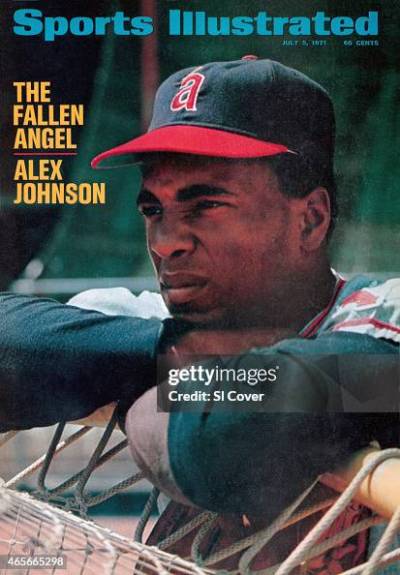
Cincinnati offered Johnson something he badly needed: a clearer path to regular at-bats. The Reds’ coaching staff also worked to simplify his hitting approach, encouraging him to rely on his natural strength and quick hands. In 1967, he hit .273 with 17 home runs—a noticeable improvement. He followed with another solid year in 1968, though his relationship with management sometimes became strained because of his intensity and the perception that he was aloof or difficult to coach. Still, his talent was unmistakable. After the 1968 season, the Reds—always active in roster construction—traded Johnson again, this time to the California Angels.
It was with the Angels that Alex Johnson would finally flourish. California believed Johnson would be a cornerstone of their offense, and manager Lefty Phillips expressed confidence in Johnson from the start. That trust paid off. In 1969, his first season with the Angels, Johnson hit .312 and began showing signs of becoming one of the league’s toughest hitters. He sprayed line drives to all fields, ran the bases aggressively, and showed a confidence that had sometimes eluded him. The Angels viewed him as a hitter entering his prime.
Then came 1970—the finest year of his career. Johnson hit .329, edging out Carl Yastrzemski for the American League batting title on the final weekend of the season. His .329 average stood as the highest in Angels history at the time, and he recorded 202 hits, including 36 doubles. He did all of this without being a prototypical slugger; instead, he used extraordinary bat control and the ability to hit almost any pitch hard somewhere. Pitchers often remarked that there was no safe way to pitch him because he was able to handle high fastballs, low breaking balls, and everything in between. For one brilliant season, Johnson was not just good—he was one of the best hitters in baseball.
Unfortunately, his success did not lead to long-term stability. Personality clashes, disputes over playing effort, and mounting tensions with the Angels led to suspensions and grievances during the 1971 season. After the year ended, California traded him to the Cleveland Indians. Johnson never again matched his 1970 peak, though he remained a capable hitter for several seasons with Cleveland, then Texas, and finally the Yankees before retiring in 1976.
Alex Johnson’s career remains one of baseball’s great “what-ifs.” He had immense natural talent—enough to win a batting title in a league rich with elite hitters—and his 1970 season stands as proof of his ability when everything aligned. Though his career was marked by constant movement and complex relationships with teams, for one season he was unquestionably among the most dangerous hitters in the American League.
Please scroll down to comment on this story or to give it a rating. We appreciate your feedback!

Disclaimer: Some of the products featured or linked on this website may generate income for Philly Baseball News through affiliate commissions, sponsorships, or direct sales. We only promote items we believe in, but please assume that PBN may earn a cut from qualifying purchases that you make using a link on this site.
Privacy Policy | Contact us
© 2025 LV Sports Media. All rights reserved.

 Philly Baseball News