
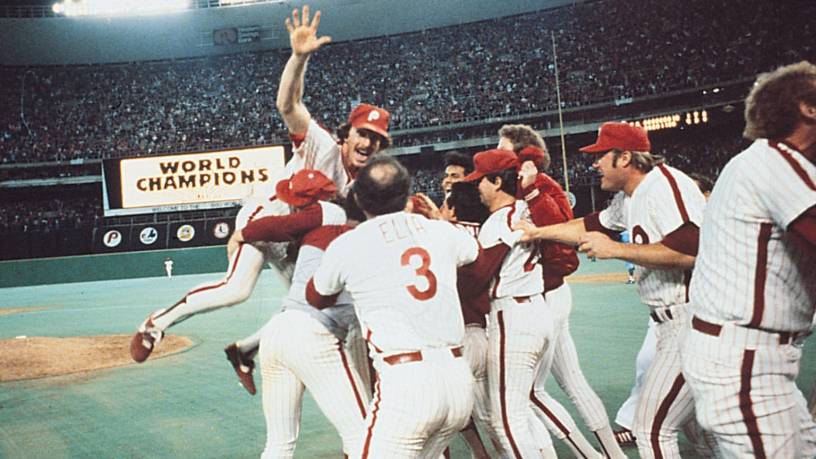
We can all picture Tug McGraw throwing heat past Willie Wilson for the final out of the 1980 World Series. That was followed by Mike Schmidt jumping into McGraw’s arms and the celebration was on. That happened 45 years ago today.
Phillies events on October 21
- October 21, 1980 — Game 6 of the World Series: the Philadelphia Phillies defeated the Kansas City Royals 4–1 to win the franchise’s first World Series championship, a game won by Steve Carlton with Tug McGraw closing and sealed by McGraw’s strikeout of Willie Wilson for the final out.
Phillies players, managers, executives, and broadcasters born on October 21:
- Justin De Fratus — born October 21, 1987 — Right-handed relief pitcher who was drafted and developed by the Phillies, made his major-league debut with Philadelphia in 2011 and pitched for the Phillies through 2015, working primarily out of the bullpen and appearing in 191 big-league games.
- José Ruiz — born October 21, 1994 — Venezuelan right-handed pitcher who spent time in the Phillies organization during his MLB career; Ruiz reached the majors in 2017 and has appeared for multiple clubs and made 68 relief appearances with the Phillies over 2024 and 2025.
- Casey Fien — born October 21, 1983 — Right-handed pitcher who spent parts of his big-league career with several clubs including a brief tenure – four games – with the Phillies. Fien was a journeyman reliever whose MLB service included time with Detroit, Minnesota, the L.A. Dodgers, and Seattle prior to finishing his career with the Phillies.
A DEEPER DIVE… World Champions!
The Philadelphia Phillies captured their first World Series title on October 21, 1980, defeating the Kansas City Royals in six games and closing the series when Tug McGraw struck out Willie Wilson for the final out late that night. The victory ended a long championship drought for a franchise that had been one of baseball’s oldest and most historically winless major-league clubs, and it instantly became the defining moment in modern Philadelphia sports history. The game’s late hour, the roar that followed, and the sight of players and fans celebrating in a city long starved for a title created an image that has endured in Philadelphia memory and baseball lore.
The series showcased the Phillies’ best players at their peak: Mike Schmidt earned World Series MVP honors after a dominant season and a clutch Fall Classic, Steve Carlton provided the veteran pitching leadership and earned the Game 6 victory, and the bullpen — anchored by Tug McGraw — closed out the series for the city. Schmidt’s 1980 campaign was an offensive landmark, and Carlton’s work on the mound that year reinforced a rotation that could match the best the American League offered; the postseason box scores and series stat lines make clear how those performances combined to lift a club that had often fallen short in previous postseasons.
What the championship meant to the franchise and the city went beyond a trophy. For the Phillies organization, the win removed the stigma of being the last of the original 16 franchises to earn baseball’s top prize and validated years of roster-building, a managerial change to Dallas Green’s tougher approach, and the patience of a fan base that had watched near-misses and painful postseason exits for decades. For Philadelphia as a whole the title became a civic release: it energized neighborhood parades, local businesses, and sports conversation for a generation and cemented the 1980 club as a cultural touchstone in a city that measures identity in part by its teams’ resilience and grit.
The series contained enduring moments and human details that keep it alive in memory. The NLCS that sent the Phillies to the World Series had been a brutal, extra-inning affair that tested the roster’s depth and resolve. Game 5 of the World Series itself featured dramatic late-inning heroics that swung momentum back to Philadelphia before the clincher two nights later. Tug McGraw’s role as both a steady late-inning arm and an emotional leader amplified the drama. His temperament and veteran presence helped steady the bullpen in critical moments and gave the clubhouse a voice that matched the team’s gritty narrative.
The image of Mike Schmidt leaping into Tug McGraw’s arms at the end of Game 6 has been replayed so often that questions have sometimes arisen about whether the moment was staged. Contemporary accounts and later recollections show the scene as the spontaneous culmination of a charged and exhausted locker-room-in-waiting moment, with McGraw reaching out to Schmidt and inviting the leap as the jubilation began rather than the two planning a staged embrace beforehand. McGraw himself revisited and even re-created the leap later in public appearances, which reinforced the mythic quality of the image but does not indicate that it was a choreographed stunt rather than an impulsive celebration by players who had just delivered on a long-sought dream.
The 1980 Phillies are remembered for the combination of statistical excellence, late-inning resilience, and dramatic character moments that turned a roster into a city’s shared memory. The series’ box scores record the performances, but the long shadows of Schmidt’s MVP season, Carlton’s veteran dominance, McGraw’s final strikeout, and the leap into an embrace remain the images that best explain why October 21, 1980, still matters in Philadelphia — as a sports triumph, a civic catharsis, and a narrative of persistence rewarded.

 Philly Baseball News