
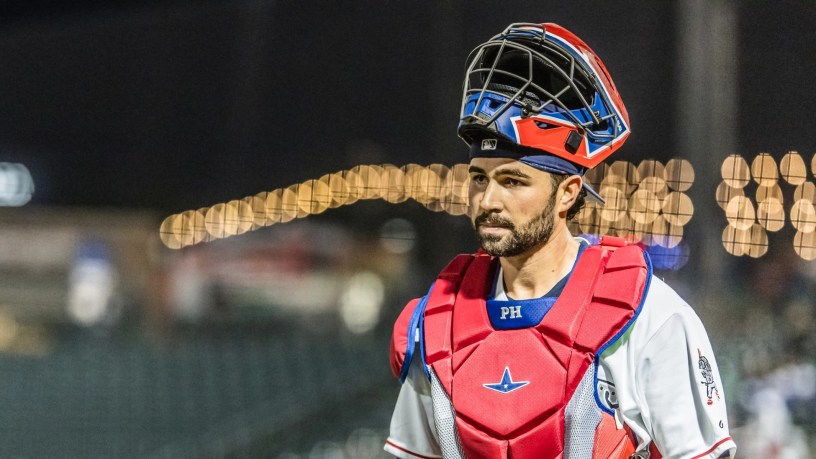
Payton Henry has been catching for a long time now; 22 years to be exact. When Henry was six he wanted to be a second baseman. He had practiced fielding a lot and had pretty good skills, so it seemed to be a natural fit. His dad had been a catcher and his team needed a catcher, so he and another coach wanted the six-year old future second baseman to become a catcher. They had a unique way on convincing him to move behind the plate but ultimately, it worked.
“My dad and one of the other coaches put me in the catcher’s gear and threw balls at me until I cried,” said Henry with a laugh. “It worked though and now I love it. There’s nowhere else I would rather play.”
After being drafted by Milwaukee in the sixth round of the 2016 Draft, Henry was dealt to the Miami Marlins in November of 2022 in a swap of minor leaguers. The deal worked out better for Miami than it did for the Brewers who received outfielder Reminton Batista in exchange. If you’re thinking “who?” You’re not alone. Batista is out of baseball and Henry reached the majors for parts of the 2021 and 2022 seasons, playing in 20 games. A year later he became a free agent and signed with Toronto and a year after that signed with the Phillies.
This season with Lehigh Valley, Henry is hitting .228 with nine home runs and 38 RBI.
With all of the catching experience he has, Henry has seen a lot of changes to the position both in rules and the fundamentals of catching. As for the fundamentals, the biggest change has been catchers going down to one knee rather than being in a full squat. The reason is to help get lower pitches called strikes and Henry believes it does help in almost every game to get a couple pitches called strikes that would have normally been called balls in the past. The downside is that it opens up the catcher to take more foul balls off of their inner thigh and other “unfortunate” spots on their body.
“Bruises are going to happen, regardless of if you’re in a traditional stance or one knee stance. I think people probably think that it’s a little bit more taxing on our body, but, At the end of the day, it’s the same,” said Henry. “We’re trying to steal strikes every game, so we’re able to stay lower and stay on the ground a little bit longer when we’re in those positions and that’s kind of the main goal is to stay down as long as we can.”
Another advantage of the one knee approach is that it can help catchers to block pitches in the dirt.
Besides using the one knee stance to get a few more strike calls, these days Henry has the added advantage of using the challenge system to get a strike call. As a catcher, he is in the unique position of having the ability to help his pitcher to get a strike and help himself to get a strike call reversed as a batter. So, does he place more importance on using them as a catcher or as a hitter?
“I’ve challenged a few as a catcher a few as a hitter. I’ve gotten couple wrong, and I’ve got a majority, right? But I still try to save them; I’d rather use them for the pitcher. It sucks getting balls called on you where you can’t do anything about it, but that’s a human part of the game, we kind of have to accept it. I’d rather save it for the end of the game when we need them, especially if it’s a tight game and and we’re trying to get a strike.”
Catchers are also at the mercy of the pitch clock from two different vantage points. As a hitter they are limited to one timeout per at-bat and have to be prepared and ready to go. As a catcher, they have to keep their pitcher moving to avoid the clock running out which can be difficult if he and the pitcher aren’t on the same page on which pitch to throw. The use of the pitchcom system, which often causes delays when it simply doesn’t work, has helped the pitcher and catcher to move through the signs faster to manage the pitch clock.
Henry believes the pitchcom system also prevents opponents from stealing signs, but does it really? There have been instances – especially in the minors this season – where runners on second are trying to pick up a pitcher’s grip on the ball when come set and some have been successful. In fact, some pitchers have purposely balked a runner over to third to avoid the spying eyes of runners on second if they or the catcher believe they are picking up on what the pitcher is throwing.
One thing it seems would certainly be more difficult being down on one knee is throwing out a would-be base stealer. In the past catchers would sometimes stay a little higher in their squat with a speedy runner on base. It would help them to raise up faster to get a strong throw off to second or third. With a runner attempting to steal third, the catcher has a more difficult time to maneuver around a right-handed batter to make a throw if they are down on one knee. From the traditional squat position, catchers get around a hitter easier to make a throw to third.
“I’ve been in a traditional stance with runners on base my whole career until this year, so it’s been a little bit of an adjustment, but I’ve done a better job, you know, stealing strikes and changing games that way than I think I ever could with the running game. There’s definitely some give and take, but we want to be good at everything, so it’s a work in progress. For me, it’s a work in progress,” said the 28-year-old Henry.
Baseball is cyclical. At some point down the road, catchers may be back in a traditional stance behind the plate or they may come up with some other stance that they believe gives them an advantage in one way or another.
Henry is right though, it’s a give and take. While catchers might be getting more low strikes called, what about high strikes? They feel they can block pitches better, but can they? Shifting left or right for pitches in the dirt has got to be more difficult when you are on one knee than if you are in a squatting position. For now, there are no real metrics to measure all of these factors but in the future there may be. The bottom line is that if a player feels one thing or another is giving them an edge, they’re going to go with it. Time will tell just long the one knee stance for catchers will last.

 Philly Baseball News