
Early Life and Athletic Roots
Ryne Dee Sandberg was born on September 18, 1959, in Spokane, Washington. Named after Yankees pitcher Ryne Duren, Sandberg grew up in a sports-loving household and quickly emerged as a standout athlete. At North Central High School, he excelled in football, basketball, and baseball, earning Parade All-America honors as a quarterback. Though he initially committed to play football at Washington State University, the Philadelphia Phillies selected him in the 20th round of the 1978 MLB Draft, and Sandberg chose to pursue baseball professionally.
Phillies Beginnings and the Trade That Shaped History
Ryne Sandberg began his minor league career in 1978 with the Helena Phillies and progressed steadily through the system. By 1981, he reached Triple-A Oklahoma City and earned a September call-up to the Phillies. He played 13 games and recorded one hit in six at-bats. Despite his potential, the Phillies saw him as blocked at shortstop by Larry Bowa and at third base by Mike Schmidt.
In January 1982, the Phillies traded Sandberg and Bowa to the Chicago Cubs for Iván DeJesús. The deal, orchestrated by former Phillies GM Dallas Green—then with the Cubs—is now considered one of the most lopsided trades in MLB history. Sandberg would go on to become a franchise icon in Chicago, while DeJesús lasted only three seasons in Philadelphia.
Cubs Stardom and Hall of Fame Career
Sandberg debuted with the Cubs in 1982 and was initially used at third base before settling into second base in 1983. From there, he blossomed into one of the greatest second basemen in MLB history. His breakout season came in 1984, when he hit .314 with 19 home runs, 84 RBIs, 32 stolen bases, and a league-leading 114 runs and 19 triples. That year, he won the NL MVP and delivered a legendary performance in the “Sandberg Game,” hitting two game-tying home runs off Hall of Famer Bruce Sutter.
Over his 16-year career (15 with the Cubs), Sandberg compiled:
- .285 batting average
- 2,386 hits
- 282 home runs
- 1,061 RBIs
- 344 stolen bases
He earned:
- 10 All-Star selections
- 9 consecutive Gold Gloves (1983–1991)
- 7 Silver Sluggers
- 1984 NL MVP
- 1990 NL home run title (40 HRs)
He retired in 1994, returned for two more seasons in 1996–97, and was inducted into the Hall of Fame in 2005.
Return to the Phillies: Minor League Managerial Career
After retiring, Sandberg remained connected to baseball and eventually returned to the Phillies organization in 2010. He was hired to manage the Triple-A Lehigh Valley IronPigs, the Phillies’ top affiliate. His arrival brought instant credibility and attention to the IronPigs, who had struggled since their inception.
In 2011, Sandberg led Lehigh Valley to its first-ever postseason appearance, guiding the team to the International League Championship Series. His leadership style—marked by quiet intensity and a deep respect for fundamentals—resonated with players and fans alike. He was named Baseball America’s Minor League Manager of the Year in 2011, a testament to his impact on player development and team culture.
Sandberg’s time in Allentown helped shape several future Phillies, and his presence gave the IronPigs a major league aura. His success at Lehigh Valley positioned him as a natural candidate for a big-league managerial role.
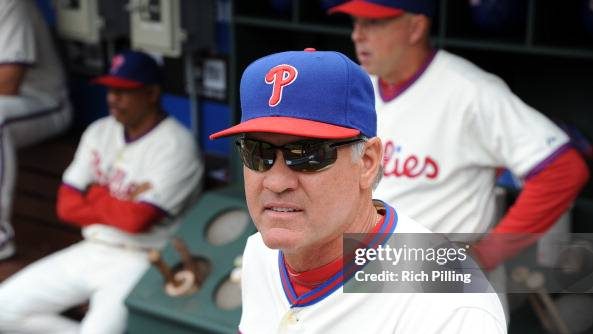
Phillies Managerial Tenure (2013–2015)
In 2012, Sandberg was promoted to the Phillies’ major league staff as third base coach and infield instructor. When Charlie Manuel was dismissed in August 2013, Sandberg was named interim manager. A month later, he was given the full-time role and signed to a three-year contract.
Sandberg’s tenure as Phillies manager coincided with a transitional period for the franchise. The team was aging, and the farm system was in flux. Despite his pedigree and leadership, the Phillies struggled on the field. Over parts of three seasons, Sandberg compiled a 119–159 record (.428 winning percentage).
He resigned in June 2015, citing the team’s direction and his own frustrations. Though his managerial stint didn’t yield playoff success, Sandberg remained respected for his professionalism and commitment to the game.
Legacy and Final Years
Sandberg returned to the Cubs in 2016 as a goodwill ambassador and occasional broadcaster. In 2024, the Cubs unveiled a statue of him outside Wrigley Field, commemorating his iconic career and the 40th anniversary of the “Sandberg Game.”
In January 2024, Sandberg announced he had been diagnosed with metastatic prostate cancer. Though he was declared cancer-free later that year, the disease returned in December. He passed away on July 28, 2025, at age 65, surrounded by family.
Final Reflections
Ryne Sandberg’s legacy is multifaceted. He was a generational talent at second base, a quiet leader who let his play speak volumes, and a respected figure in both the Cubs and Phillies organizations. His time with the Lehigh Valley IronPigs marked a high point in his post-playing career, showcasing his ability to mentor and inspire young players.
For Phillies fans, Sandberg represents a bridge between eras – a homegrown talent who found stardom elsewhere but returned to help shape the next generation. His managerial stint may not have delivered wins, but his influence on the organization was undeniable.

 Philly Baseball News