
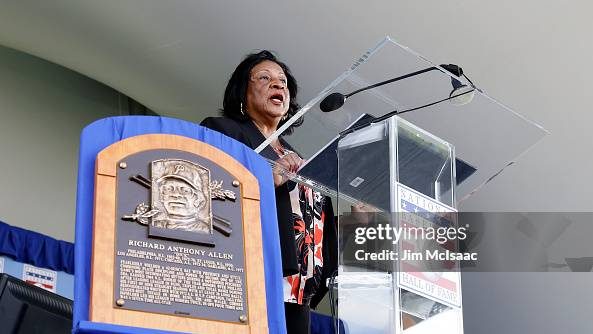
Dick Allen’s baseball journey was as powerful and complex as his swing. Over 15 seasons in Major League Baseball, Allen compiled a .292 batting average, 351 home runs, and 1,119 RBIs, earning seven All-Star selections, a Rookie of the Year award, and an MVP. But his legacy is equally defined by his turbulent relationship with fans, media, and management—especially during his time with the Philadelphia Phillies.
Early Life and Rise to the Majors
Born in Wampum, Pennsylvania, in 1942, Richard Anthony Allen was a multi-sport star in high school. He signed with the Phillies in 1960 for a then-record $70,000 bonus. His minor league path included a harrowing stint in Little Rock, Arkansas, where he became the first Black player on the team and endured intense racial hostility. Despite the adversity, he led the International League in home runs and RBIs in 1963 and earned a September call-up to the Phillies.
Rookie Sensation in Philadelphia
Allen’s first full season in 1964 was historic. Playing third base – a position he had never regularly manned – he led the National League in runs (125), triples (13), and total bases (352), while batting .318 with 29 home runs and 91 RBIs. He was named NL Rookie of the Year and helped the Phillies contend for the pennant until their infamous 10-game collapse in the final weeks.
Despite his brilliance, Allen’s time in Philadelphia was marred by tension. Fans and media insisted on calling him “Richie,” a nickname he disliked and considered infantilizing. He also led the league in errors at third base, which fueled criticism despite his offensive dominance.
Controversies and Conflict
Allen’s relationship with the Phillies soured over the next several seasons. In July 1965, he was involved in a clubhouse altercation with teammate Frank Thomas. Accounts suggest Thomas made racially charged remarks and swung a bat at Allen, striking him. The Phillies released Thomas the next day but forbade players from discussing the incident, allowing public perception to turn against Allen. Many fans blamed him for Thomas’s departure, and the backlash was swift and ugly.
Allen began wearing his batting helmet in the field to protect himself from objects thrown by fans—including batteries and fruit. He was booed relentlessly, even as he continued to produce at an elite level. In 1966, he led the league in slugging (.632) and OPS (1.027), and hit 40 home runs.
Further incidents followed: in 1967, Allen injured his hand pushing it through a car headlight; in 1969, he was fined and suspended for missing a doubleheader after attending a horse race. These episodes, combined with his strained relationship with the media and management, led to his trade to the St. Louis Cardinals after the 1969 season.
Journeyman Years and MVP Glory
Allen played one season with the Cardinals and one with the Dodgers before landing with the Chicago White Sox in 1972. Under manager Chuck Tanner, Allen thrived. Playing first base exclusively, he won the AL MVP with a .308 average, 37 home runs, and 113 RBIs. His leadership and performance were credited with revitalizing the franchise and keeping it in Chicago amid relocation rumors.
Allen played two more seasons with the White Sox, leading the AL in home runs again in 1974. He briefly retired before returning to the Phillies in 1975. Though older and less dominant, he helped mentor younger players and contributed to the team’s 1976 NL East title. However, his second stint in Philadelphia ended quietly, and he finished his career with the Oakland Athletics in 1977.
Legacy and Hall of Fame Recognition
Allen’s career was defined by contradictions: immense talent and frequent controversy, fan adoration and hostility, statistical excellence and media skepticism. Sabermetricians long championed his Hall of Fame case, citing his .912 OPS and 156 OPS – numbers that rivaled the game’s greats during a pitching-dominated era.
After missing Hall of Fame induction by one vote in two separate committee ballots, Allen was finally enshrined in 2025 by the Classic Baseball Era Committee. His plaque bears the cap of the Phillies, the team where his legend – and his battles – were forged.
Allen’s story is not just about baseball. It’s about race, identity, and resilience. He played angry, as he once said, but he played brilliantly. And now, his place in Cooperstown ensures that his legacy will be remembered in full.

 Philly Baseball News