
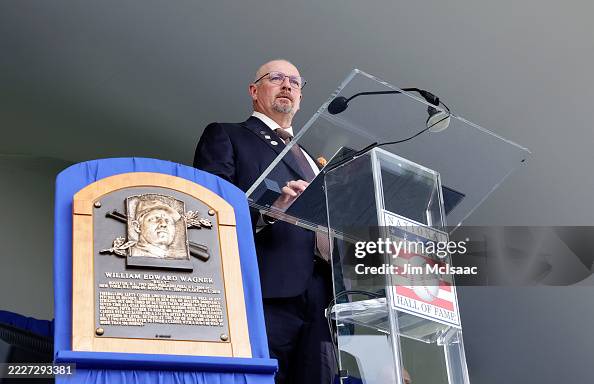
Billy Wagner’s baseball career is a story of resilience, dominance, and a fastball that defied physics. Born in Marion, Virginia, Wagner overcame a turbulent childhood and a pair of broken arms that led him to switch from throwing right-handed to left-handed – a twist of fate that would shape his Hall of Fame legacy.
Drafted 12th overall by the Houston Astros in 1993 out of Division III Ferrum College, Wagner quickly rose through the minors and debuted in the majors in 1995. By 1997, he had claimed the closer role and began a stretch of dominance that made him one of the most feared relievers in baseball. His 1999 season was especially electric: 39 saves, a 1.57 ERA, and 124 strikeouts in 74.2 innings, earning him the NL Rolaids Relief Man Award and a fourth-place finish in Cy Young voting.
Wagner spent nine seasons with Houston, racking up 225 saves—a franchise record—and three All-Star selections. But after the 2003 season, tensions with Astros management boiled over. Wagner had publicly criticized the front office for not building a playoff-caliber roster, and despite posting a career-high 44 saves that year, he was traded to the Philadelphia Phillies on November 3, 2003. Houston received Brandon Duckworth, Taylor Buchholz, and Ezequiel Astacio in return.
In Philadelphia, Wagner continued to shine. Though injuries limited him in 2004, he rebounded in 2005 with one of the best seasons of his career: a 1.51 ERA, 38 saves, and a league-leading 70 games finished. He struck out 87 batters in 77.2 innings and earned another All-Star nod. His fiery demeanor and elite performance made him a standout, even as the Phillies fell short of postseason play during his tenure.
After two seasons in Philly, Wagner signed with the New York Mets in 2006, continuing his dominance with 101 saves over four years. He later pitched for the Red Sox and Braves, retiring in 2010 after a stellar final season in Atlanta with a 1.43 ERA and 37 saves.
Over 16 seasons, Wagner compiled 422 saves (eighth all-time), a 2.31 ERA, and 1,196 strikeouts in 903 innings. His strikeouts-per-nine rate (11.9) and opponent batting average (.187) remain among the best ever for a reliever. In 2025, he was inducted into the National Baseball Hall of Fame, becoming the first left-handed reliever to earn the honor.
Wagner’s induction to the Hall of Fame
Billy Wagner’s Hall of Fame induction speech was a heartfelt reflection on a remarkable journey from small-town obscurity to baseball immortality. Speaking in Cooperstown, Wagner opened with humility and awe, acknowledging the surreal nature of standing among legends he once idolized. He paid tribute to his roots in southwest Virginia and Ferrum College, a Division III school, emphasizing how unlikely his path had been—from a 5-foot-nothing kid who learned to throw left-handed after breaking his right arm twice, to becoming the first left-handed reliever ever enshrined in the Hall of Fame.
Wagner’s speech was rich with gratitude. He thanked his family, especially his wife Sarah and son Will, for their unwavering support, and credited his faith as the foundation of his perseverance. “Without you, none of this would be possible,” he said, referencing his Christian beliefs. He also acknowledged the Hall of Fame staff for making the experience seamless and memorable.
He shared humorous and touching anecdotes, including advice from former teammate Russ Springer about bullpen dynamics, and childhood memories of watching Johnny Bench on “The Baseball Bunch.” Wagner noted how broadcasters like Skip Caray and Milo Hamilton shaped his love for the game, and how Chip Caray called his final outing as a Brave—bringing his career full circle.
Wagner honored his former teams, starting with the Houston Astros, who drafted him and gave him his first shot. He thanked owner Drayton McLane and GM Bill Wood for believing in a small-town kid with a big fastball. He also expressed appreciation for the Phillies, specifically Bill Giles and Dave Montgomery, for showing him what true passion looked like—from the organization to its fans.
He gave special shoutouts to fellow inductees: CC Sabathia for his power and passion, Ichiro Suzuki for his elegance and precision, and posthumous honorees Dave Parker and Dick Allen for their strength and trailblazing legacies. Wagner’s words were especially poignant when he spoke of overcoming obstacles, urging young players to treat setbacks as steppingstones rather than roadblocks.
The speech was peppered with emotion, humor, and reverence. Wagner joked about bullpen hierarchies, praised teammates like Jeff Bagwell and Craig Biggio for their leadership, and even thanked Moises Alou for introducing him to Dominican culture—despite Wagner’s admission that he “can’t speak a lick of Spanish”.
In closing, Wagner reflected on the full-circle nature of his career and the lessons baseball taught him about resilience, professionalism, and gratitude. His induction wasn’t just a personal triumph—it was a celebration of grit, heart, and the enduring magic of the game.
You can read the full transcript on the Houston Chronicle’s website or watch the full speech on MLB.com.

 Philly Baseball News