
The Main Event
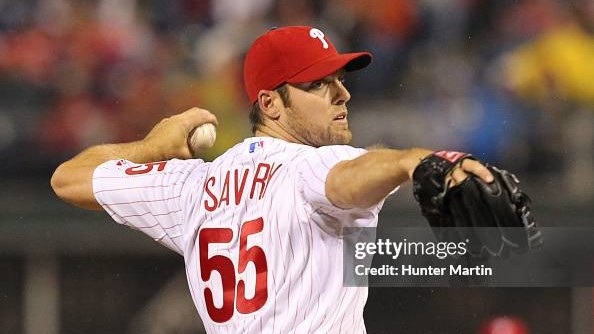
February 17, 2014 – The Phillies lost left-handed pitcher Joe Savery on waivers to the Oakland Athletics, trimming their 40-man roster shortly before spring training activities intensified.
Joe Savery carved out a reputation early as a rare two-way talent, a player who could genuinely help a team both on the mound and in the batter’s box. That versatility was fully on display during his time at Rice University, one of college baseball’s most demanding and prestigious programs. At Rice, Savery wasn’t treated as a novelty act. He was trusted in meaningful situations as both a left-handed pitcher and a capable hitter, often playing first base when he wasn’t pitching. His bat had real value, particularly against right-handed pitching, and his disciplined approach at the plate reflected the same polish he showed on the mound. Rice’s coaching staff leaned into that flexibility, helping Savery develop a mature feel for the game that would define much of his professional career.
The Phillies selected Savery in the 23rd round of the 2008 MLB Draft, a pick that reflected both intrigue and uncertainty. Two-way players are exciting, but professional baseball tends to push players toward specialization. The Phillies initially allowed Savery to continue hitting in the lower minors, and he responded by showing solid on-base skills and occasional power. At the same time, his left arm offered promise. He wasn’t overpowering, but he commanded the strike zone well and mixed pitches effectively.
As Savery moved through the Phillies’ system, the organization gradually emphasized pitching. By the time he reached Double-A Reading and Triple-A Lehigh Valley, his future was clearly on the mound. Even then, his background as a hitter influenced his approach. Savery understood how hitters thought, which helped him sequence pitches and attack weaknesses. That feel for the chess match between pitcher and batter became one of his calling cards.
Major league debut and Phillies tenure
Savery reached the majors with the Phillies in 2011, making his debut during a stretch when the club relied heavily on depth arms. Used primarily as a left-handed reliever, he filled a situational role, often asked to neutralize tough left-handed hitters. His numbers at the major league level were uneven, but his willingness to adapt and his calm presence on the mound earned him continued opportunities.
In the minors, Savery was a stabilizer. He bounced between roles, sometimes starting, sometimes relieving, depending on organizational need. His experience as a former two-way player made those transitions smoother than they might have been for others. Even when his velocity ticked down, his command and competitiveness kept him in the conversation. The Phillies valued that reliability, especially during seasons when roster churn was constant.
Life after Philadelphia
After being claimed off waivers by the Oakland Athletics in 2014, Savery’s career took on a journeyman shape. Oakland appreciated his left-handed depth, though his time there was brief. He continued to pitch in affiliated baseball, as well as in independent leagues, where his experience and adaptability made him a useful veteran presence. Later, Savery also pitched internationally, extending his career and embracing roles that went beyond pure performance, including mentorship of younger players.
A unique baseball path
Joe Savery’s career doesn’t fit neatly into traditional categories. He was never a star, but he was consistently interesting. His ability to hit and pitch at high levels shaped how teams viewed him and how he viewed the game. Even after specializing as a pitcher, that two-way foundation never disappeared. It informed his approach, his preparation, and his understanding of the sport’s nuances.
In the end, Savery’s time with the Phillies stands as the central chapter of his professional story. It was there that his two-way promise became a major league reality, even if only briefly. His career is a reminder that baseball paths don’t have to be linear to be meaningful, and that versatility, intelligence, and persistence can carry a player farther than raw tools alone.
Philadelphia Baseball Events for February 17
February 17, 1995 – With the 1994 players’ strike still unresolved, the Phillies opened spring training using a roster largely made up of minor leaguers and replacement players. Camp included former major leaguers such as Marty Bystrom, Todd Cruz, Jeff Stone, and Greg Legg, reflecting the uncertainty surrounding the upcoming season.
February 17, 1996 – The Phillies signed veteran left-handed pitcher Terry Mulholland as a free agent, bringing him back to Philadelphia for a second stint. He had also pitched for the Phils from 1989-1983.
February 17, 2005 – Philadelphia signed left-handed pitcher Antonio Bastardo as an amateur free agent out of the Dominican Republic. Bastardo debuted with the Phillies in 2009 and pitched for them through 2014.
February 17, 2021 – Philadelphia signed free agent Brad Miller to a one-year contract, bringing back a versatile infielder who had played with the Phillies in 2019 after being purchased from the New York Yankees. (“Bamboo” Brad Miller and Embracing The Superstitions)
February 17, 2023 – The Phillies signed reliever José Alvarado to a three-year contract extension. Alvarado came to Philly as part of a three-team trade with Tampa Bay and the LA Dodgers.
Elsewhere…
February 17, 1995 – With the strike still unresolved and spring training set to begin, Tigers manager Sparky Anderson is put on an involuntary leave of absence as he refuses to manage replacement players. The Orioles announce they will not play exhibition games against teams using replacement players, further weakening the owners’ preferred option to force the striking players into submission.
ICYMI
PBN –The Next CBA Could Bring Changes to Player Development
Phillies.com – World Series or Bust: Phillies Believe They Can Finish The Job in ’26
Philadelphia Inquirer – The Phillies Will Test Drive the ABS Challenge System This Spring
The Athletic (subscription required) – Andrew Painter Begins an Important Spring Training With a Higher Arm Slot
Philadelphia Baseball Birthdays for February 17
Roger Craig (born 1930) – Right-handed pitcher who finished his major league playing career with the Phillies in 1966. After signing as a free agent, Craig was released in July with a 5.56 ERA. He would go on to manage the Padres for two seasons and San Francisco for eight seasons, taking the Giants to a National League championship in 1989. The World Series was delayed by an earthquake prior to Game 3 between the Giants and Oakland.
Dave Roberts (born 1951) – Infielder and catcher who was acquired from Houston late in spring training and appeared with the Phillies in 29 games during the 1982 season, prior to being released in May and never returning to a major league roster. (This is NOT the Dave Roberts who is currently the manager of the Dodgers.)
Cody Ransom (born 1976) – Utility infielder who spent part of the 2010 season with the Phillies after signing a minor-league deal, appearing in 22 games and filling multiple infield roles. (Phillippe Aumont Loves Hockey; Cody Ransom Does Not)
Deivy Grullón (born 1996) – Catcher originally signed by the Phillies as an international free agent who rose through the organization and made his major-league debut with Philadelphia in 2019. Played in a total of five MLB games – four with Philly in 2019 and one with Boston in 2020, batting .167 (2-12).
Please scroll down to comment on this story or to give it a rating. We appreciate your feedback!
Disclaimer: Some of the products featured or linked on this website may generate income for Philly Baseball News through affiliate commissions, sponsorships, or direct sales. We only promote items we believe in, but please assume that PBN may earn a cut from qualifying purchases that you make using a link on this site.
Privacy Policy | Contact us
© 2025 LV Sports Media. All rights reserved.

 phillybaseball.news