
The Main Event
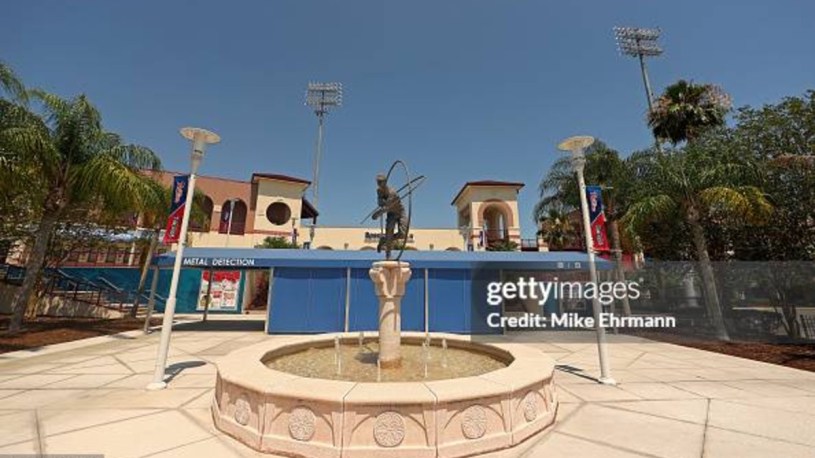
With the start of Spring Training, it’s a good time to look at the history of where the Phillies have spent the springs of the past. They have been in Clearwater for 79 years now, but what about before that?
In the very earliest days of the franchise, the Phillies did not travel far for their spring preparations. In the 1880s and very early 1890s, they trained at their home ballpark in Philadelphia, Recreation Park. Spring workouts back then were simple affairs, and the team pitched, batted and got ready for the long season right in their own backyard. In 1901, the club began heading south seeking warmer weather ahead of Opening Day, marking the beginning of a long period of shifting Spring Training homes. Over the next several decades, the Phillies tried more than twenty locations across a wide swath of the eastern United States and into Texas, laying out tents or packing into small parks wherever conditions allowed. They held camp in places like Washington, Southern Pines and Wilmington in North Carolina, Savannah and Augusta in Georgia, Birmingham, Alabama and even Hot Springs, Arkansas at Fogel Field in 1912. They also trained in Leesburg, Bradenton, Winter Haven and Miami Beach in Florida, and at times even returned north during World War II when travel restrictions forced teams to hold spring activities closer to home in places like Hershey, Pennsylvania and Wilmington, Delaware. These stops were often selected based on a mix of climate, available facilities and travel logistics, as teams in that era lacked the consolidated training complexes modern clubs enjoy.
The Move to Clearwater Begins a New Era
After decades of roaming, the Phillies found a more permanent home in Clearwater, Florida beginning in 1947. Prior to that year, the Cleveland Indians and Brooklyn Robins — who later became the Dodgers — had used Clearwater Athletic Field for spring workouts, and the Phillies jumped at the city’s invitation after the Indians left in 1946. Clearwater at that time was a small town with less than 15,000 residents, a peaceful setting that offered consistent warm weather and the community welcome the Phillies sought. The team and city officials signed a long-term agreement, and in late February of 1947 the Phillies held their first spring practice at Athletic Field. Players often had to deal with modest facilities — the outfield surface was rough and sand-filled — and housing was limited, but the warmth and support for the team were undeniable. Clearwater quickly became a destination where the Phillies were able to focus on preparation in a setting that was both sunny and forgiving compared to the lingering winter in the Northeast.
Clearwater Athletic Field: The First Site (1947-1954)
The Phillies’ first stop in Clearwater was modest but important. Clearwater Athletic Field hosted spring camps from 1947 through 1954. The deal with the city was originally for a single year, but it blossomed into a decade-long relationship as the Phillies and Clearwater found mutual benefit in the arrangement. The players lived in local hotels and made do with facilities that were far from glamorous by modern standards, but the consistency of the site helped the club build stronger routines and a fan base in the region. As time went on, local leaders recognized the value of investing in baseball infrastructure to support the Phillies and bring fans to town.
Jack Russell Stadium: The Longest Single Home (1955-2003)
In 1955, the city of Clearwater and the Phillies opened a new stadium built specifically with spring training in mind. Named Jack Russell Stadium after a local commissioner and Phillies supporter, this ballpark became home for Phillies spring games for nearly half a century, an extraordinary run by any standard. It was a step up from Athletic Field, offering better seating, more reliable amenities and a venue that fans and players embraced. The stadium stood for 49 seasons, bearing witness to countless Phillies bright springs and early season battles under the Florida sun. Its long tenure underscores a period when the Phillies and Clearwater grew together, with the club’s identity increasingly tied to its Gulf Coast home.
Carpenter Complex and Minor League Integration
While Jack Russell Stadium hosted the big team’s games and workouts, the Phillies also invested in a broader spring training infrastructure. In 1967 the club opened what was then Carpenter Field, a multi-field complex in Clearwater dedicated to minor league workouts, batting practice, player instruction and organizational training. Over time this site expanded and was renamed the Carpenter Complex in honor of the Phillies’ long-time owner Robert Carpenter. It became an essential part of the Phillies spring routine, giving young players a place to refine their skills alongside the big league squad and fostering deeper organizational development in one location.
Bright House Networks Field / Spectrum Field / BayCare Ballpark: The Modern Home (2004-Present)
In 2004 the Phillies opened a brand-new spring training ballpark adjacent to the Carpenter Complex, originally called Bright House Networks Field and later renamed Spectrum Field and more recently BayCare Ballpark. This facility was designed with modern amenities, including a 360-degree concourse and increased capacity, giving fans a more comfortable and interactive experience. The field’s dimensions and feel were modeled in part after Citizens Bank Park, further tightening the connection between the spring training site and the Phillies’ regular season home. Since its opening, this ballpark has hosted the Phillies every spring, and along with the Carpenter Complex it forms the heart of the organization’s Florida operations. The team’s consistency in Clearwater makes it the longest continuous relationship in Phillies history and one of the longest in professional baseball. Fans make the pilgrimage each year to catch early action, and the warm weather, welcoming community and deep tradition make Clearwater not just a training site but a second home for the franchise.
Philadelphia Baseball Events of February 12
February 12, 1930 – After leading his Philadelphia Athletics to the 1929 World Championship, Connie Mack becomes the first sports figure to receive the prestigious Edward W. Bok Prize for service to the city of Philadelphia.
February 12, 2014 – The Philadelphia Phillies signed veteran right-hander A. J. Burnett to a one-year, $15-million contract after Cole Hamels announced he would not be ready for Opening Day due to shoulder tendinitis. To make room for Burnett on the 40-man roster, the club designated pitcher Joe Savery for assignment; Savery was later claimed off waivers by the Oakland Athletics.
ICYMI
PBN – Phillies to Castellano: Just Stay Home
PBN – Analysis: Ranking the NL East Farm Systems
PBN Extra Innings – Ranking the Top 15 Prospects in the NL East (subscription required)
The Athletic by Charlotte Varnes – The Phillies and Zack Wheeler Remain Optimistic (subscription required)
NBC Sports Philadelphia by Cole Weintraub – Zack Wheeler’s Souvenir Says Plenty About His Recovery
Phillies.com by Todd Zolecki – The Phillies Clubhouse Looks a Bit Different This Year
Philadelphia Baseball Birthdays for February 12
Jim Fogarty (born 1864) – Outfielder who debuted with the Philadelphia Phillies in 1884 and played six seasons with them before becoming a player-manager for the Philadelphia Quakers in 1890.
Kiddo Davis (born 1902) – Outfielder who played with the Philadelphia Phillies in two different stints (1932 and 1934). Hit a combined .302/.351/.416/.767 in Philadelphia.
Dennis Springer (born 1965) – Made four starts for the Phillies in 1994 before playing for California/Anaheim, Tampa Bay, Florida, NY Mets, and LA Dodgers.
Ruben Amaro Jr. (born 1965) – Born in Philadelphia, Amaro Jr. played in two different stints with the Phillies (1992-1993, 1996-1998). Also served as a Phillies bat boy, front office executive, and General Manager. Is currently a Phillies TV analyst.
Hall of Famers born on February 12
Chick Hafey (born 1903) – Played 13 seasons with St. Louis and Cincinnati. Had a career 164 home runs and 833 RBI with a slash line of: .317/.372/.526/.898. Led the NL in hitting with a .349 average in 1931 and in slugging (.590) in 1927.
Please scroll down to comment on this story or to give it a rating. We appreciate your feedback!
Disclaimer: Some of the products featured or linked on this website may generate income for Philly Baseball News through affiliate commissions, sponsorships, or direct sales. We only promote items we believe in, but please assume that PBN may earn a cut from qualifying purchases that you make using a link on this site.
Privacy Policy | Contact us
© 2025 LV Sports Media. All rights reserved.

 phillybaseball.news