
We have changed up the format for our This Date in Phillies History feature. No more burying the lead at the bottom of the post, and we’re including some Phillies information from around this thing called the internet. We hope you enjoy the new format. You can always find any edition of the feature by using the “Phillies History” drop down at the top of the site. From there, just click on “This Date in Phillies History.”
The Main Event
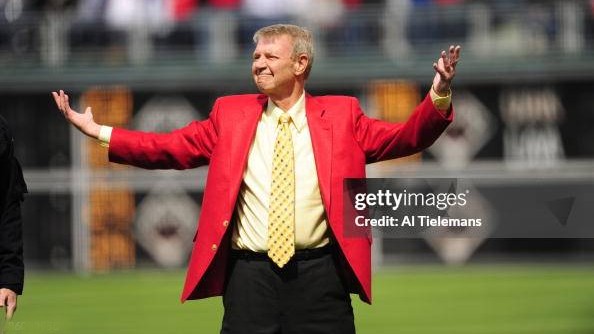
January 31, 2002: Longtime Phillies broadcaster Harry Kalas was named the winner of the Ford C. Frick Award, earning recognition and enshrinement in the broadcasters’ wing of the National Baseball Hall of Fame.
Harry Kalas was born on April 26, 1936, in Naperville, Illinois, and grew up loving baseball, radio, and the sound of a well-told game. That mix shaped his future. After serving in the U.S. Army, he worked his way through minor league broadcasting jobs before landing in Houston in the mid-1960s. There, with the Astros, he refined the rich baritone voice and relaxed storytelling style that would later become iconic. By the time he arrived in Philadelphia in 1971, Kalas was already respected within the industry, but few would have predicted just how deeply he would embed himself into the identity of one franchise.
Kalas joined the Phillies’ broadcast team at a pivotal moment. The club was emerging from decades of frustration, and the fan base was hungry for relevance. Kalas became the perfect companion for that journey. His delivery was unhurried, confident, and welcoming. He treated listeners like friends sitting next to him in the booth, trusting them to understand the game rather than talking down to them. As the Phillies rose to prominence in the 1970s, Kalas’ voice became inseparable from the experience of following the team.
His signature home run call, “That ball is outta here,” became one of the most recognizable phrases in baseball broadcasting. It was never forced. Kalas waited until the ball’s fate was clear, then let the words land with authority and joy. For Phillies fans, hearing that phrase often meant something important had just happened.
October Moments and Iconic Calls
Kalas was behind the microphone for some of the most important moments in Phillies history. He called the franchise’s first World Series championship in 1980, bringing calm clarity to a moment decades in the making. When Tug McGraw struck out Willie Wilson to clinch the title, Kalas let the crowd breathe before delivering a call that felt both celebratory and dignified.
He was also part of the broadcast team for the dramatic 1993 season, a year that reconnected the city with its baseball team. Kalas captured the chaos, humor, and emotion of that group, from Lenny Dykstra’s grit to Mitch Williams’ intensity. Even in heartbreak, like the loss to Toronto in the World Series, Kalas maintained perspective and empathy for the fans listening at home.
Later, he called the Phillies’ return to championship glory in 2008. His voice again framed a defining moment when Brad Lidge struck out Eric Hinske to end the World Series. For many fans, that call felt like a bridge between generations, linking 1980 and 2008 through the same steady voice.
Harry and Whitey
Harry Kalas’ friendship with Richie Ashburn was one of the great behind-the-scenes relationships in Phillies history, and it came through clearly on the air. When Ashburn joined the broadcast booth in 1963 and Kalas arrived in 1971, the two men were at very different points in their careers, but they fit together almost instantly. Ashburn, the Hall of Fame center fielder, brought the perspective of a former player who had lived the game from the inside. Kalas brought the broadcaster’s instincts, the timing, and the voice. What made it special was the mutual respect. Kalas never tried to upstage Ashburn’s stories, and Ashburn trusted Kalas to set him up, then get out of the way. Their conversations felt natural, like two friends talking baseball rather than announcers performing a script.
Off the air, the friendship was just as strong. Ashburn became a mentor to Kalas, not only in understanding the Phillies and their fans, but in learning how to balance humor, honesty, and criticism. Ashburn’s dry wit paired perfectly with Kalas’ gentle timing, leading to countless memorable exchanges that fans still quote today. Kalas often said that working with Ashburn made him a better broadcaster, and when Ashburn passed away in 1997, Kalas spoke openly about how much he missed his partner and friend. For many Phillies fans, the Kalas-Ashburn booth remains the gold standard, not just because of what they said, but because of the genuine friendship that shaped every broadcast.
Beyond Philadelphia
While Kalas is best remembered for his Phillies work, his career extended well beyond one team. He called national games for NBC, including Major League Baseball and NFL broadcasts. One of his most famous non-Phillies moments came during Super Bowl XVII, when his call of John Riggins’ long touchdown run for Washington became part of NFL lore. That broadcast showcased his versatility and his ability to rise to the biggest stages without changing who he was.
Despite national success, Kalas always returned to Philadelphia as his professional home. He valued the daily rhythm of a baseball season and the long-term relationship with a fan base more than the spotlight of occasional national assignments.
Hall of Fame Recognition
In 2002, Kalas received the Ford C. Frick Award, earning his place in the National Baseball Hall of Fame. The honor recognized not just longevity, but excellence, integrity, and impact. During his induction speech, Kalas emphasized gratitude and humility, speaking about the privilege of being welcomed into fans’ lives every day. He talked about broadcasting as a shared experience and acknowledged that a great announcer is shaped as much by the audience as by the microphone.
One of the most remembered sentiments from that speech was his emphasis on responsibility. He spoke about respecting the game, the players, and the listeners, and about never forgetting that fans invest real emotion in what they hear. That mindset defined his entire career.
GO DEEPER INTO THE PHILLIES! PLEASE SUPPORT PHILLY BASEBALL NEWS WITH A FREE 7-DAY TRIAL TO OUR SUBSTACK: PBN EXTRA INNINGS.
Harry Kalas passed away on April 13, 2009, just days before the start of another Phillies season. His death was felt immediately and deeply across Philadelphia. Players, fans, and fellow broadcasters mourned not just a voice, but a constant presence. Today, recordings of his calls still circulate, and his phrases remain part of the Phillies’ cultural vocabulary.
Kalas’ legacy is not just in what he said, but in how he said it. He proved that authority and warmth can coexist, that excitement does not require shouting, and that trust between broadcaster and audience is earned over time. For Phillies fans and for baseball as a whole, Harry Kalas remains the gold standard of what a broadcaster can be.
A Little Light Reading From PBN
- Our ABL Scouting Reports continue with outfielder Manolfi Jimenez.
- The rest of the ABL Scouting Reports are also available: Jose Colmenares, Alirio Ferrebus, Camron Hill
Elsewhere…
- The Enquirer has their list of the Top 10 Phillies Prospects
Philadelphia Baseball Events of January 31
January 31, 1952: The Philadelphia Phillies settle a damage suit with former pitcher Art Lopatka, who alleged the club made him pitch with an injury and released him once he was no longer useful, a notable legal aftermath in club history.
January 31, 1971: Shortstop Dave Bancroft, who spent the first six years of his 16 MLB seasons with the Phillies, was elected to the National Baseball Hall of Fame by the Veterans Committee.
January 31, 1974: Traded catcher Mike Ryan to Pittsburgh for Jackie Hernandez. “Irish” Mike Ryan played six seasons with the Phillies. Hernandez had played nine seasons in the majors, but was released by the Phillies in April of ’74 and re-signed with Pittsburgh, but did not play in the majors after the trade.
January 31, 1980: The Phillies signed right-handed pitcher Lerrin LaGrow as a free agent, adding a veteran arm to the roster ahead of the 1980 season. He made 25 relief appearances with a 4.10 ERA in what would be his final MLB season.
January 31, 1983: The Phillies add two players to the team that would become known as “The Wheeze Kids.” Veteran first baseman Tony Perez and infielder/outfielder Bill Richardson signed one-year contracts with the Phillies. Richardson had played with the Phillies in 1982 after being acquired from Pittsburgh, but was a free agent following that season and re-signed with the Phillies.
Elsewhere… January 31, 1962: San Francisco Giants star Willie Mays signs the largest contract in major league baseball, reportedly $90,000 for the upcoming season. Mays will earn every penny in 1962, when he bats .304 with 49 home runs and 141 RBI and helps the Giants to the National League pennant. Exactly 34 years later, Ken Griffey Jr. signs the largest contract in MLB history when he gets four years and $34-million with Seattle.
Philadelphia Baseball Birthdays of January 31
Bob Ferguson (born 1845) — Early major league player and manager who played for and managed the Phillies for 17 games in 1884 and was fired after posting a 4-13 record. Ferguson was known as a tough, versatile infielder who also pitched in 11 games in his career.
Mel Mazzera (born 1914) — Outfielder who played parts of five major league seasons, four of them for the St. Louis Browns and his final season (1940) with the Phillies. Mazzera was a first baseman and outfielder who contributed as a left-handed bat and fielder.
Ed Wade (born 1956) — Phillies executive from Carbondale, Pennsylvania whose front-office career included roles as a scout and general manager.
Jake Thompson (born 1994) — Right-handed pitcher who was traded to the Phillies in the 2015 deal for Cole Hamels. He made 18 starts and 12 relief appearances over parts of three seasons with the Phillies.
Also… Hall of Famers Ernie Banks (1931) and Nolan Ryan (1947) were born on January 31.
Please scroll down to comment on this story or to give it a rating. We appreciate your feedback!
Disclaimer: Some of the products featured or linked on this website may generate income for Philly Baseball News through affiliate commissions, sponsorships, or direct sales. We only promote items we believe in, but please assume that PBN may earn a cut from qualifying purchases that you make using a link on this site.
Privacy Policy | Contact us
© 2025 LV Sports Media. All rights reserved.

 Philly Baseball News