
Phillies Events
- 1937: Nap Lajoie was elected to the National Baseball Hall of Fame. He’s a fun “cross-era Philly” name because he played for the Phillies in the 1890s before becoming a star for the Philadelphia Athletics in the early 1900s.
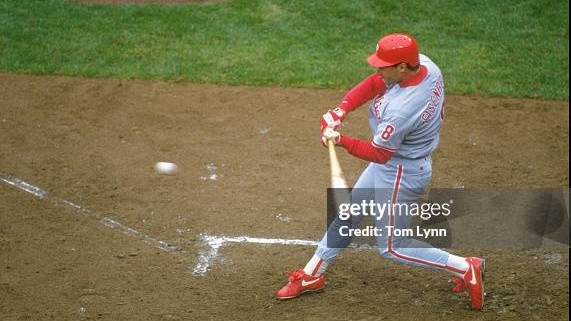
- 1993: The Phillies signed outfielder Jim Eisenreich as a free agent. Eisenreich hit .318 for the ’93 Phillies and became a fan favorite in Philadelphia.
- 2010: The Phillies agreed to terms with reliever Chad Durbin on a one-year contract. Durbin had originally joined the Phillies for the 2008 season and left after 2010, but returned for his final MLB season in 2013.
- 2010: The Phillies signed right-hander Brandon Duckworth to a minor league contract. Duckworth started his career with the Phillies before pitching for Houston and Kansas City. He never appeared for the Phillies in 2010.
Phillies Birthdays
- Joe Straub (born 1858): Straub played eight games with the Philadelphia Athletics in 1882. Overall, he played in three seasons with a .153 career batting average.
- Fred Lucas (born 1903): Born in Vineland, NF, Lucas made it to the majors with the 1935 Phillies after a long minor-league grind. His career consisted of 20 games played in 1935.
- Dib Williams (born 1910): He played big-league infield for the Philadelphia Athletics in the early 1930s, including their 1931 World Series run.
- Ken Dowell (born 1961): He briefly reached the majors and played in 15 games with the Phillies in 1987, after coming up through the Phillies organization.
- Jeff Juden (born 1971): Juden was acquired from the Phillies in December, 1993 in the trade that sent Mitch Williams to the Astros. He made 15 starts and four relief appearances with the Phillies in 1994 and 1995.
- Amaury Telemaco (born 1974): Spent six seasons with the Phillies and posted a 5.08 ERA. In his final three seasons though he posted a 4.16 ERA in eight starts and 48 relief appearances.
- Victor Cardoza (born 2006): A minor league outfielder in the Phillies organization who played in the Florida Complex League and with Low-A Clearwater in 2025. He hit a combined 3-15-.222/.287/.342 in 47 games last season.
A DEEPER DIVE… Nap Lajoie and his two-team Philadelphia experience
Nap Lajoie’s baseball story begins in Woonsocket, Rhode Island, where he grew up as a gifted athlete with quick hands and uncommon bat control. He broke into professional baseball in the 1890s and quickly earned a reputation as a natural hitter able to square up almost anything thrown his way. The Philadelphia Phillies purchased his contract from Fall River of the New England League in 1896, bringing him to the National League when he was just 21 years old. Almost immediately, Lajoie showed he belonged. He hit over .300 in all five of the seasons he played with the Phillies and became one of the club’s most reliable offensive players at a time when offense was often hard to come by.
Playing primarily second base, Lajoie combined soft hands with a strong throwing arm, but it was his bat that truly separated him. He was a line-drive hitter who used the entire field and rarely looked overmatched. By 1900, he was one of the league’s elite players, batting .337 while driving in runs at a steady clip. Philadelphia fans embraced him as a homegrown star, and he looked like a cornerstone player for years to come.
The Jump to the American League and the Famous Legal Battle
The baseball world changed dramatically in 1901 when the American League declared itself a major league and began aggressively signing National League stars. Lajoie jumped to the new Philadelphia Athletics, signing a lucrative contract and instantly becoming the face of Connie Mack’s young franchise. The move triggered one of the earliest major contract disputes in baseball history. The Phillies sued, claiming they still owned his rights, and a Pennsylvania court issued an injunction that barred Lajoie from playing for the Athletics in the state.
Rather than lose their star entirely, the Athletics temporarily assigned him to the Cleveland franchise so he could legally play road games while the case dragged on. That odd workaround led to Lajoie becoming the centerpiece of baseball in Cleveland, where he would remain for more than a decade. The legal wrangling itself became part of baseball lore and highlighted the growing pains of the sport as leagues fought for talent and legitimacy.
Dominance in Cleveland and Peak Stardom
Once settled in Cleveland, Lajoie delivered one of the great offensive peaks in baseball history. In 1901, he hit .426, a modern-era record that still stands today, while leading the league in hits, runs, and doubles. He followed that season with year after year of elite production, regularly batting over .350 and winning multiple batting titles. Fans adored him so deeply that the team was even nicknamed the “Naps” in his honor, a rare tribute that underscored his impact and popularity.
| Season | Age | WAR | G | PA | AB | R | H | 2B | 3B | HR | RBI | SB | BA | OBP | SLG | OPS | OPS+ | TB |
|---|---|---|---|---|---|---|---|---|---|---|---|---|---|---|---|---|---|---|
| 1901 | 26 | 8.3 | 131 | 582 | 544 | 145 | 232 | 48 | 14 | 14 | 125 | 27 | .426 | .463 | .643 | 1.106 | 198 | 350 |
Generated 1/19/2026.
bold font means he led the AL.
bold italic font means he led all of Major League Baseball.
Lajoie was not just a hitter. He played a steady second base, showed leadership on the field, and eventually served as a player-manager. His calm demeanor and professionalism made him a natural centerpiece for a young franchise trying to build credibility and fan loyalty.
After many productive seasons in Cleveland, Lajoie returned to Philadelphia in 1915, this time with the Phillies. Although he was no longer in his prime, he provided veteran stability and baseball intelligence to a club that was emerging as a National League power. He appeared in the 1915 World Series with the Phillies, giving him a rare chance to play on baseball’s biggest stage late in his career. He finished his major league playing days in 1916, closing the loop on a career that began and ended in Philadelphia.
Legacy and Lasting Impact
Nap Lajoie retired with a lifetime batting average of .338, over 3,200 hits, and a reputation as one of the purest hitters the game has ever seen. He was elected to the National Baseball Hall of Fame in 1937, part of the early wave of legends recognized for shaping the sport’s foundation. His unique connection to both the Phillies and the Athletics, combined with the famous legal saga that sent him to Cleveland, makes him one of the most fascinating figures of baseball’s early era.
What stands out most about Lajoie is how modern his offensive approach feels even today. He valued contact, balance, and consistency rather than brute strength, and those traits allowed him to dominate in a dead-ball era defined by strategy and precision. His career bridges multiple chapters of baseball history and ties directly into Philadelphia’s deep baseball roots, making him a perfect example of how the city helped shape the national game.
Please scroll down to comment on this story or to give it a rating. We appreciate your feedback!
Disclaimer: Some of the products featured or linked on this website may generate income for Philly Baseball News through affiliate commissions, sponsorships, or direct sales. We only promote items we believe in, but please assume that PBN may earn a cut from qualifying purchases that you make using a link on this site.
Privacy Policy | Contact us
© 2025 LV Sports Media. All rights reserved.

 Philly Baseball News