
Phillies Events on January 18
January 18, 1938 — Hall of Fame election: Phillies great Grover Cleveland Alexander, who starred for Philadelphia early in the 20th century and helped the 1915 club to its first pennant, was elected to the National Baseball Hall of Fame on this date.
January 18, 2002 — Third baseman Scott Rolen avoided salary arbitration with the Phillies by agreeing to a one-year, $8.6 million contract, which at the time was the largest contract in team history under arbitration.
Phillies Birthdays on January 18 (All Years)
Ralph Caldwell (born 1884) — A left-handed pitcher born in Philadelphia who spent two seasons in the majors, both of which were with the Phillies. He made seven starts and six relief appearances in 1904 and 1905 and posted a career mark of 3-5 with a 4.20 ERA.
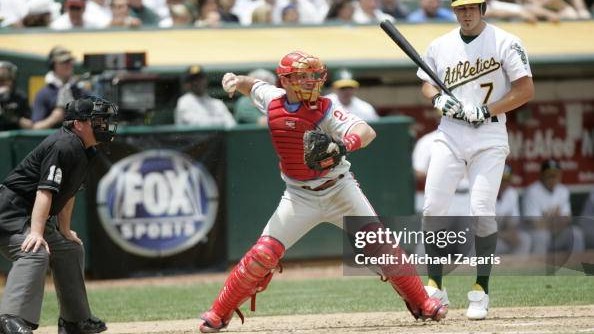
Mike Lieberthal (born 1972) — Lieberthal was a long-time Phillies catcher who was drafted by the Phillies with the third overall pick in the 1990 Draft. “Lieby” played 13 of his 14 MLB seasons with the Phillies prior to finishing his career with the Dodgers in 2007. Known for being a solid offensive player and excellent defensive player, who is a member of the Phillies Wall of Fame after being inducted in 2012.
George Hesselbacher (born 1895) — Philadelphia native and pitcher who pitched briefly for the Philadelphia Athletics in 1916. His entire career consisted of four starts and two relief appearances resulting in a 7.27 ERA with the A’s in 1916.
A DEEPER DIVE… Mike Lieberthal
The Phillies took Mike Lieberthal with the third overall pick in the 1990 draft, betting big on a Southern California high school catcher with both bat speed and the poise that is needed to run a pitching staff. Four years later, he debuted in the majors on June 30, 1994, and in a neat little bit of symmetry, it came against the Dodgers, who he would finish his career with. That early chapter set the tone for a career that was rarely flashy, but incredibly steady and valuable in the way teams actually win games: handling pitchers, controlling the running game, and still producing real offense at a position where that’s often a bonus.
Lieberthal’s name is most tightly linked to the late 1990s and early 2000s Phillies, when he became the backbone of the club’s day-to-day baseball competence. Catcher is a job that asks you to be part strategist, part traffic cop, part psychologist, and then also hit enough to justify your spot in the lineup. Lieberthal had a stretch where he did all of it at a level that put him in rare company for the position.
His signature season was 1999. He hit .300, launched 31 home runs, drove in 96, made the All-Star team, and won the Gold Glove. That combination matters because it’s hard enough for catchers to mash, and it’s hard enough for catchers to be elite defenders, but doing both in the same season is a season that you have to pay attention to. He followed by making another All-Star team in 2000, giving him back-to-back midsummer nods.
Quiet milestones and a lot of responsibility
The “Lieberthal story” is also a volume story. The Phillies trusted him, constantly. The club’s own Wall of Fame plaque notes he became the franchise’s all-time leader among catchers in games caught (1,139), home runs (149), and hits (1,128), and that he started 10 consecutive Opening Days behind the plate for the Phillies. Those are not accidental totals. You only get there if managers and pitching coaches sleep well when you’re behind the plate, and you only keep that job if the staff feels like you’re adding value every day.
There were highlights that pop even if you weren’t watching every night. One of the biggest: he caught Kevin Millwood’s no-hitter on April 27, 2003, a moment that’s as much about the catcher’s planning and feel as it is about the pitcher’s stuff.
Injuries, durability, and the catcher tax
Catching takes a toll, and Lieberthal’s career has the usual reminders of that. He dealt with significant injuries along the way, including knee trouble and a pelvic stress fracture during the 1997 season that cut into what looked like it was going to be a monster year for Lieberthal. That context matters when you evaluate his numbers, because catchers don’t just miss time, they often play through being compromised physically, which can change everything from swing mechanics to throwing. The fact that he still produced 150 career homers and a .274 average while doing the job is a pretty good summary of how skilled and tough he was.
A quick Dodgers coda and the decision to walk away
After the 2006 season, Lieberthal finished his playing career with a one-year stop in Los Angeles, signing with the Dodgers in December 2006. It wasn’t the storybook ending where he plays three more seasons and rides into the sunset on a pennant. It was more realistic than that: he was a veteran catcher, on the back end of a physically demanding career, trying to squeeze out whatever baseball was left. The Dodgers declined his 2008 option, and he retired on January 27, 2008, noting he would have played another year if that option had been picked up.
In Philadelphia, though, the ending is much warmer. The Phillies inducted him into the team’s Wall of Fame on August 10, 2012, formalizing what fans already knew: for a long stretch; he was the catching standard in this town. Wall of Fame status tends to go to players who were either iconic, excellent for a long time, or both. Lieberthal lands in that “excellent for a long time” category, with enough peak to make the résumé feel complete.
Please scroll down to comment on this story or to give it a rating. We appreciate your feedback!

Disclaimer: Some of the products featured or linked on this website may generate income for Philly Baseball News through affiliate commissions, sponsorships, or direct sales. We only promote items we believe in, but please assume that PBN may earn a cut from qualifying purchases that you make using a link on this site.
Privacy Policy | Contact us
© 2025 LV Sports Media. All rights reserved.

 Philly Baseball News