
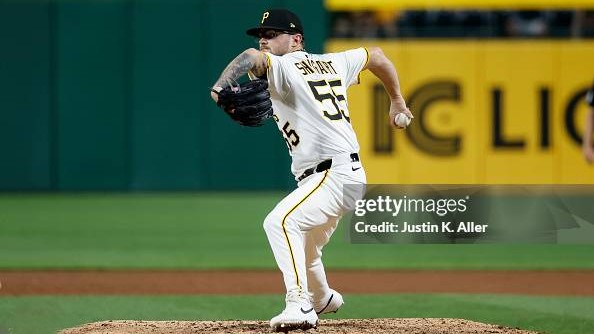
Chase Shugart is a right-hander from Bridge City, Texas who went the college route and pitched at the University of Texas. Shugart’s story is pretty straightforward: he was a good enough high school athlete to show up on plenty of radars, then became a useful, sometimes-high-leverage arm for the Longhorns before pro ball pulled him in.
Boston drafted Shugart in the 12th round of the 2018 Draft. From there he did what a lot of middle round, college reliever-starter-swingman types do. He climbed level by level, bounced between roles, and basically kept himself in the conversation by throwing strikes, taking the ball often, and showing enough stuff to miss bats when the matchups were right. By the time he finally got big league looks, he already had a lot of mileage in the minors: 176 appearances, 404.0 innings, a 4.54 ERA, and 378 strikeouts (with 52 starts mixed in along the way).
Take a deeper journey into our Phillies coverage with a free or paid subscription to
PBN Extra Innings; the companion site to PhillyBaseball.News.

The headline on Shugart’s minor league career is volume and versatility. Over those 404 innings, the run prevention projects more as a solid organizational arm with stretches of strong usefulness than a guy who projects as a lock for the rotation. The strikeout total shows there has always been at least some ability to finish hitters. The other thing that matters is that his usage and pitch mix make a lot more sense in shorter bursts, which helps explain why his major league runway has been most realistic as a bullpen piece.
Shugart’s MLB debut came August 15, 2024, and by the end of the 2025 season he had logged 41 big league games, 53.2 innings, and a 3.52 ERA with 39 strikeouts. Most of that meaningful sample came in 2025 with Pittsburgh, where he worked 35 games and put up a 3.40 ERA across 45.0 innings.
What he throws and how he uses it
According to Statcast, Shugart leans on five pitches, and the shape of the mix screams bullpen matchup guy who can get groundballs and ugly swings. In 2025, his most-used pitch was a sweeper at about 29% usage, then a cutter around 25%, a sinker around 20%, then a four-seamer around 19%, and a changeup sprinkled in around 7%.
Velocity-wise, the fastball power is real. The four-seamer averaged about 95.4 mph and the sinker about 94.3. The cutter sat around 89.9, the changeup about 88.2, and the sweeper lived around 81.0.
Effectiveness for Shugart depends on how you want to measure it. The sweeper is the main swing-and-miss offering, with the best whiff rate of the group in 2025, but the cutter also misses a fair number of bats, and it can be a tone-setter early in counts or a finisher when hitters are geared up for 95. The sinker is more about contact management than pure whiffs, and the four-seamer plays like a power pitch that can still get hit hard if it leaks into predictable spots. The changeup is clearly a “show it” pitch just to give hitters something else to think about.
Sabermetric clues in normal person language
First, the run prevention has outpaced some of the “what should have happened” indicators so far. FanGraphs has him at a 3.52 ERA in MLB with a 4.56 FIP, which is basically a stat that tries to judge a pitcher more on strikeouts, walks, and homers than on the defense behind him. Statcast-style contact indicators point in a similar direction, with an MLB xERA (expected ERA) shown at 4.37 alongside the same 3.52 ERA. That does not mean he has been bad, it just suggests there has been some combination of timing, sequencing, and batted-ball luck helping the ERA look prettier than the underlying components.
Second, he is not a pure bat-misser in the majors yet. His MLB strikeout rate sits around 18.0% (slightly low), with a walk rate around 9.2% (slightly high). That’s workable for a reliever, but it puts pressure on location and pitch selection because you don’t have unlimited margin when you are not simply blowing everyone away. Home runs have been part of the picture too, with an MLB HR/9 around 1.17.
Third, the batted-ball quality is a mixed bag. On the one hand, Shugart’s overall hard-hit rate in the majors is not alarming in the abstract. On the other hand, when hitters do square him up, the peak contact can be loud, which matches the idea that he needs to stay disciplined with execution when he goes to the four-seamer and sinker.
Pitch-by-pitch, you can see a clear “this is what works” hierarchy. In 2025, the sweeper was his top pitch to miss bats and generally kept expected results in a reasonable place, which is why he leaned on it most. The cutter also graded well by Statcast’s pitch-level run values, and it gave him a second breaking look that helps him avoid being a one-trick slider guy. The sinker and four-seamer were more volatile, with lower whiff rates and some indicators that contact quality can jump if those pitches catch too much of the plate.
Health, injuries, and the “did it slow him down” question
The biggest clearly documented injury note in the recent big league window is a left knee inflammation stint in July 2025, which cost him time and required a rehab assignment before he returned. A knee issue is different from an elbow or shoulder problem in terms of long-term pitcher panic, but it can still matter because it messes with landing, timing, and command. In a pitcher like Shugart, where execution is a big part of the success equation, any disruption to consistency can show up quickly in walks or in the mistake pitch home run.
So what’s the scouting report in one concise paragraph?
Shugart looks like a legit bullpen option who survives with variety, not just raw overpowering dominance. He has real velocity, a sweeper that can get ugly swings, and a cutter that gives him another angle to keep hitters from sitting on one shape. The upside version is a steady middle-relief arm who can steal bigger outs when the sweeper is sharp and the fastballs are well-spotted. The risk version is that, because the strikeout and walk profile has been more “okay” than “elite,” the margin is thinner when command wobbles, and that’s when the expected stats start to look more like the true talent than the ERA does.
Please scroll down to comment on this story or to give it a rating. We appreciate your feedback!

Disclaimer: Some of the products featured or linked on this website may generate income for Philly Baseball News through affiliate commissions, sponsorships, or direct sales. We only promote items we believe in, but please assume that PBN may earn a cut from qualifying purchases that you make using a link on this site.
Privacy Policy | Contact us
© 2025 LV Sports Media. All rights reserved.

 Philly Baseball News