

MLB’s Competitive Balance Tax (CBT), usually called the luxury tax, is baseball’s way of discouraging runaway payrolls without having a hard salary cap. If a team’s “CBT payroll” finishes above a preset threshold, the team pays a tax on every dollar over that line. The key thing is that it’s not based on what a team pays in cash that year. It’s based mostly on contract average annual value (AAV) plus player benefits, calculated across the 40-man roster.
The current thresholds come from the 2022–26 CBA: $230M (2022), $233M (2023), $237M (2024), $241M (2025), and $244M (2026).
So when you hear “the Phillies are over the tax,” it’s not simply “their payroll is huge.” It’s “their CBT payroll, as defined by the CBA math, finished above the threshold.”
How the tax rates and penalties work
There are two layers: the base rate (based on how many consecutive years you’ve been over) and surcharge rates (based on how far over you are).
Base rate is straightforward:
- First year over: 20%
- Second straight year: 30%
- Third straight year (or more): 50%
Then come the “you’re really over” surcharges. Under the current rules there are additional surcharge tiers starting at $20M over the threshold, with higher surcharges as you climb further past the line.
And here’s a penalty that fans often miss because it’s not “money”: if a club is $40M or more above the CBT threshold, its top selection in the next MLB Draft gets moved back 10 spots (with a top-six protection that pushes the penalty to the next-highest pick instead).
That draft-pick kicker matters because it turns “just pay the tax” into “pay the tax and pay in future talent.”
Where the CBT money goes
This is one of the most misunderstood parts. The CBT isn’t a simple “big-market teams pay, small-market teams collect” pot.
Under the current Basic Agreement:
- The first $3.5-million of CBT proceeds each year goes to defray clubs’ obligations under the MLB Players Benefit Plan.
- Of what remains, 50% goes to players’ individual retirement accounts.
- The other 50% goes into a Supplemental Commissioner’s Discretionary Fund, distributed to revenue-sharing payee clubs based on formulas tied to non-media local revenue growth and other factors (attendance, marketing/fan engagement efforts, competitiveness, etc.).
So yes, some of it ends up supporting lower-revenue clubs, but a big chunk is tied directly to player benefits and retirement.
How it changes free agency and trades, with the Phillies in mind
The CBT is basically a pressure system. It doesn’t stop teams from spending, but it shapes behavior.
For the Phillies, it’s been a real and growing factor because they’ve been over the threshold multiple years in a row. In 2025, for example, Philadelphia’s reported CBT bill jumped to a franchise-record $56,062,903. That’s not just a line item. That’s money that ownership has to be willing to burn every season, and it gets steeper when you’re a repeat offender.
Here’s what it does to decision-making:
In free agency, AAV is the headline number for CBT planning. A team might be okay paying a player $30M in actual 2026 salary if the CBT hit is different due to structure, deferrals, or bonuses. The Phillies (like every team) care about the CBT number because it’s what triggers rates, surcharges, and the draft-pick penalty.
In trades, CBT turns into a chess game. At the deadline, contenders often demand cash from the selling team or route deals through a third team so the CBT hit is smaller. If the Phillies are trying to add a big salary midseason, it’s not only “is the player worth it,” it’s “does this push us into another surcharge tier or into the draft pick penalty zone?”
It also changes the “shape” of a roster. Teams near the line are apt to prioritize:
- cheaper relievers instead of pricey bullpen shopping
- internal bench options
- one big move instead of two medium moves
- contracts with lower AAV even if the total dollars are similar
Bo Bichette as a Phillies case study
Bo Bichette is a player who forces the CBT conversation into the open when it comes to him signing with the Phillies. In the realm of Bichette’s free agency, the Phillies are thinking about two numbers at the same time: his baseball value and his CBT footprint.
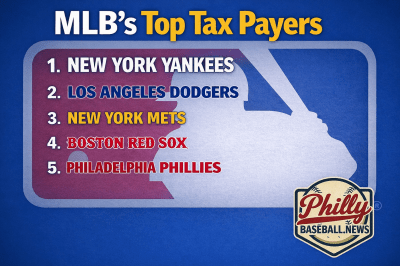
The Phillies are already projected to be above the CBT line going into 2026, then adding a significant AAV doesn’t just increase the tax bill. It can push them across meaningful cliffs, especially crossing the $20-million overage surcharge range and the $40-million overage range where the draft pick gets shoved back 10 spots.
That doesn’t mean they can’t do it. It means the front office has to decide whether the upgrade is worth the compound costs: cash tax, steeper repeater rates, and if it would wind up costing them draft position. If you’re wondering why a team that has money to spend still hesitates, that’s the CBT story in one sentence.
Will there be changes to the Luxury Tax in the next CBA?
Two things to watch:
First, the current Basic Agreement explicitly says there will be no CBT in place after the 2026 season, which is basically the CBA’s way of saying “this system must be renegotiated.” So the structure is guaranteed to be a bargaining issue, not a maybe.
Second, labor tension is already pointing toward bigger economic fights. There’s been renewed owner-side interest in something closer to a salary cap system, and the league’s argument is basically that the CBT isn’t constraining top-end spending the way they want. The union, historically, hates the idea of a cap, and that’s the type of disagreement that can drive a nasty negotiation.
The best guess is that rather than a full cap is a reworked CBT: higher thresholds, different surcharge bands, harsher non-monetary penalties, or changes to how proceeds are distributed. But the Dodgers and Mets spending sprees have made it harder for owners to sell “competitive balance” with a straight face unless they also push for stronger spending restraints.
Get a big bag of popcorn! It’s going to be interesting to see how the Bo Bichette and the CBA issues both play out over the next year. At least in the case of Bichette there should be a resolution one way or another before too long.
Please scroll down to comment on this story or to give it a rating. We appreciate your feedback!

Disclaimer: Some of the products featured or linked on this website may generate income for Philly Baseball News through affiliate commissions, sponsorships, or direct sales. We only promote items we believe in, but please assume that PBN may earn a cut from qualifying purchases that you make using a link on this site.
Privacy Policy | Contact us
© 2025 LV Sports Media. All rights reserved.

 Philly Baseball News