
December 28 events in Phillies history
- December 28, 2011: The Phillies signed right-hander Ricardo Pinto as an amateur free agent. Pinto has pitched in 31 games for the Phillies in two different stints (2017 and 2024) with an 8.70 combined ERA. He has also pitched for Tampa Bay and spent a season pitching in Korea.
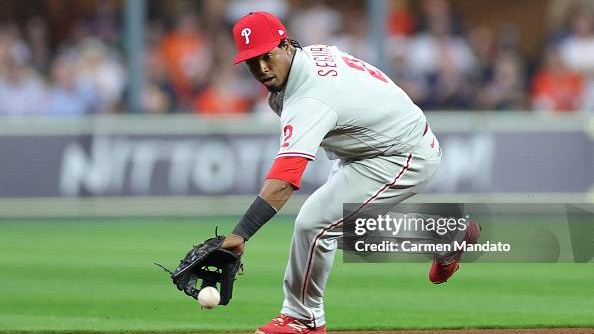
- December 28, 2022: Jean Segura agreed to a deal with the Miami Marlins, officially making him a former Phillie. Segura played four seasons with the Phillies producing a stat line of: 43-176-.281/.337/.418.
Phillies personnel born on December 28
- Bill Kelly (1898) – A first baseman who played for both the Philadelphia Athletics (1920) and the Phillies (1928), comprising his only two major league seasons. While he only played in 32 big league games, Kelly played in over 1,300 minor league games.
- Andy Musser (1937) – Phillies broadcaster and one of the defining voices for a huge stretch of Phillies baseball (1976–2001). Musser passed away in 2012.
- Bryson Ware (2000) – Phillies minor league infielder/outfielder who was drafted by the Phillies in the eighth round of the 2023 Draft. Ware played for both High-A Jersey Shore and Double-A Reading in 2025.
- Aaron Combs (2001) – Originally drafted in the eights round of the 2024 Draft by the Chicago White Sox, the Phillies acquired him in exchange for minor league pitcher Tyler Gilbert on January 1, 2025. Combs missed most of last season with an injury, but pitched for both Clearwater and Jersey Shore.
A DEEPER DIVE… The career of Andy Musser
Andy Musser’s path to becoming one of the most familiar voices in Philadelphia sports was not flashy or fast, and that fact ended up defining much of his legacy. Born in 1937, Musser came to broadcasting through persistence rather than hype. He worked his way up through minor league baseball and regional broadcasting jobs, learning the rhythms of the game and the craft of describing it for listeners who often relied on the radio as their primary connection to baseball. By the time he joined the Phillies broadcast team in the mid-1970s, Musser had already developed a steady, authoritative delivery that felt trustworthy, even comforting. That tone mattered in Philadelphia, a city that demands authenticity and has little patience for broadcasters who sound artificial or detached.
Musser officially joined the Phillies radio booth in 1976 and quickly became part of the soundtrack of a franchise that was entering one of the most successful eras in its history. He was not introduced as a star, and he never tried to be one. Instead, he arrived as a professional broadcaster who treated the game seriously and respected the intelligence of his audience.
The Golden Era of Phillies Broadcasts
To understand Musser’s career, it helps to understand just how beloved Phillies broadcast teams were during his time. The late 1970s through the early 2000s represented something of a golden age for Phillies fans on radio and television. This was the era of Harry Kalas, Richie Ashburn, Tim McCarver, and later Chris Wheeler; names that loom large in franchise history and are still spoken of with reverence. These were broadcasters with enormous personalities, signature phrases, and deep emotional connections to the fan base.
Musser worked alongside them, often sharing the booth with people who naturally drew more attention. Kalas had the booming voice and national reputation. Ashburn brought Hall of Fame credibility and homespun humor. Wheeler had energy and enthusiasm that connected instantly with younger fans. In that environment, Musser was sometimes overlooked, even though he was a constant presence and a critical stabilizing force.
What set Musser apart was his ability to balance those personalities. He was the straight man in the room, the broadcaster who reset the tone after a joke or who brought focus back to the field during a tense moment. His play-by-play was clean, accurate, and unpretentious. He let the game breathe, which is something radio listeners especially appreciate during long seasons.
A Trusted Voice Through Change
Musser’s career with the Phillies spanned dramatic changes in the organization. He called games during the buildup to the 1980 World Series championship, through the heartbreaks of the 1980s, the lean years of the 1990s, and into the renaissance that followed. For fans who stuck with the team through all of it, Musser became a familiar companion. Even when the team struggled, the broadcasts felt professional and grounded.
He had a reputation inside the organization for being exceptionally prepared. Musser did not rely on catchphrases or theatrics. He relied on information, timing, and clarity. When something important happened, listeners knew they would understand it clearly because Musser explained it plainly. That reliability helped maintain fan trust during periods when on-field results were inconsistent.
Despite being part of such popular broadcast teams, Musser never quite received the same level of public recognition as some of his colleagues. That was not due to lack of talent. It was more a reflection of his understated style and willingness to share the spotlight. In many ways, he embodied the idea that a great broadcast booth needs more than just stars. It needs glue.
Legacy and Lasting Impact
Andy Musser remained with the Phillies until 2001 when he retired from broadcasting. In January of 2012, Musser passed away bringing about a reaction from fans and colleagues that made it clear how deeply he was respected. Many listeners realized only then how much they relied on his voice and presence. He had been part of their daily routine for decades, quietly anchoring broadcasts while others came and went.
Musser’s legacy is not built on viral calls or iconic catchphrases. It is built on consistency, professionalism, and a genuine respect for the game and its audience. He helped make Phillies broadcasts feel credible and complete during an era when radio still mattered immensely. While he may be remembered as a somewhat overlooked part of legendary broadcast teams, his importance becomes clearer with time. Without voices like Andy Musser, those celebrated booths would not have worked nearly as well.
In a city that values authenticity, Musser earned something better than fame. He earned trust.
Please scroll down to comment on this story or to give it a rating. We appreciate your feedback!
Disclaimer: Some of the products featured or linked on this website may generate income for Philly Baseball News through affiliate commissions, sponsorships, or direct sales. We only promote items we believe in, but please assume that PBN may earn a cut from qualifying purchases that you make using a link on this site.
Privacy Policy | Contact us
© 2025 LV Sports Media. All rights reserved.

 Philly Baseball News