
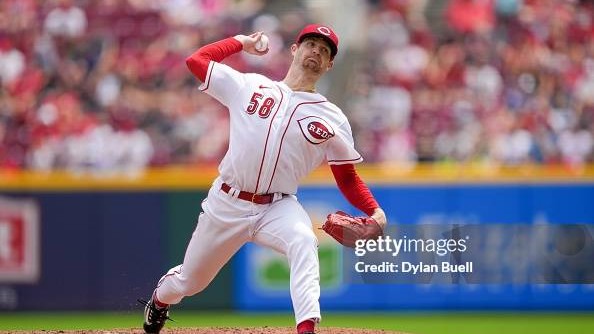
Levi Stoudt is a right-hander from the Pottstown, Pennsylvania area who went the college route at Lehigh University and built a reputation as a durable Friday-night type capable of handling real workloads. Lehigh’s bio of Stoudt notes that in 2019 he worked as their ace, piling up innings, strikeouts, and multiple complete games in Patriot League play. He also got a well-regarded summer look on the Cape (Orleans), which is often where pro scouts get extra conviction on college arms.
Seattle drafted Stoudt in the third round of the 2019 MLB Draft (97th overall), making him one of the higher-drafted players in Lehigh program history. The big “but” is that his pro career effectively started with rehab. He had Tommy John surgery right after signing, which wiped out the normal ramp-up you’d want for a college draftee and pushed his game debut back. That matters because it helps explain why his development has felt stop-and-start at times, even when the raw arm strength looked like it belonged.
Stoudt’s name pops up in a meaningful transaction: he was one of the arms tied to the Luis Castillo trade (the Reds and Mariners swapping pieces around the 2022 deadline). After his Reds stretch, Seattle re-claimed him off waivers in February 2024, and Baltimore claimed him off waivers from Seattle just four months later. Baltimore later designated him for assignment and outrighted him off the 40-man which is where the Phillies come in, signing him to a minor-league deal with the Phillies in December 2025.
Minor league performance, in plain English
The overall minor league line tells a pretty consistent story: he has missed bats at times, but he’s also had stretches where walks and homers turned innings into crooked numbers. From 2022-2024, he logged a “starter-ish” number of innings even though he was pitching as a reliever. His ERA bounced from “workable” to “rough,” and his 2024 line included 34 appearances and 85 innings across multiple affiliates. In 2023 at Triple-A Louisville, the run prevention was a problem (6.23 ERA in 82.1 innings) and the traffic was heavy, which lines up with the control and contact issues that show up in his big-league snapshot as well. By 2025, he was used more like a traditional reliever, and that transition did not immediately smooth things and he struggled at Triple-A Norfolk with a 6.93 ERA and a 17-to-14 strikeout-to-walk mark over 24.2 innings.
Major league results and what to make of them
Stoudt’s MLB résumé is very small, so it’s best to treat it like a glimpse, not a verdict. He made four appearances for the Reds in 2023 (two starts), totaling 10.1 innings with a 9.58 ERA and a 2.32 WHIP. Those stats scream “not ready,” but the more interesting part is that the quality-of-outcome metrics point to him pitching better than the ERA suggests. Baseball Savant had his 2023 xERA at 5.23, which is still not pretty, but it suggests some combination of bad sequencing, rough luck, or damage clustered in the worst possible spots.
Pitch mix, velocity, and how each pitch played in the majors
In the majors (again, tiny sample), Stoudt leaned on a four-seam fastball and a slider as the backbone of his arsenal, with a curveball and a changeup sprinkled in. Savant shows his pitch usage as roughly 48% four-seamers, 35% sliders, 9% curveballs, and 8% changeups. His average four-seam velocity sat around 94.4 mph, the slider around 84 mph, the curveball around 78 mph, and the changeup around 82 mph.
Effectiveness-wise, the slider is the pitch that flashes the most upside. MLB data from 2023 shows that it generated a strong swing-and-miss rate with about one-third of swings ending in whiffs. It also held hitters to much better expected results than his fastball did. The fastball, meanwhile, got hit. Savant’s pitch-level line shows opponents batting well against it with loud contact indicators, which is usually what happens when a fastball is in the zone but not quite getting the life, location, or deception it needs at the highest level. The curveball was used rarely and the results were noisy, which is what you’d expect from a pitch thrown only a handful of times in a season’s worth of MLB sample.
Sabermetric clues to strengths and weaknesses (without the calculus)
If you’re looking for the quick “what works, what doesn’t,” Savant paints a pretty clear outline. The encouraging signs are that he has real velocity, he can spin and shape a slider that misses bats, and his overall expected ERA was meaningfully lower than his actual ERA in 2023. The red flags are just as loud: his walk rate in that MLB sample was high (BB% shown at 14.5%), his strikeout rate was modest (K% 16.4%), and hitters did damage when they connected (HardHit% listed at 47.4%) with an average exit velocity allowed over 92 mph. Put simply, it’s hard to survive in the majors when you’re giving out extra baserunners and also allowing loud contact. The “path forward” for a pitcher like this is usually one of two things: either the fastball plays better through improved command and better spots, or the slider becomes such a problem pitch that it carries the profile and lets everything else play up.
Injuries and how they intersect with development
The biggest injury marker is the Tommy John surgery right after the 2019 draft. For pitchers, that often changes the early-career timeline more than it changes the long-term ceiling, but it can impact feel and command as you rebuild innings and confidence. In 2023, Stoudt also had a right rib cage strain that landed him on the injured list for about two weeks, which is the type of “annoying” injury that can mess with rhythm and mechanics even if it’s not career-altering.
Overall scouting summary and what it means for the Phillies
The cleanest way to describe Stoudt is: big-league arm strength, a slider that can miss bats, and a track record that has not yet found stable strike-throwing and damage control at Triple-A or in his short MLB window. If the Phillies are the landing spot, the developmental goal is pretty obvious. Get him into the zone more often without turning the fastball into a batting-practice pitch, and lean into the slider as the put-away offering. If that happens, he has a real chance to fit as useful depth, either as a spot starter who can cover innings or as a bullpen arm whose stuff plays up in shorter bursts.
Please scroll down to comment on this story or to give it a rating. We appreciate your feedback!

Disclaimer: Some of the products featured or linked on this website may generate income for Philly Baseball News through affiliate commissions, sponsorships, or direct sales. We only promote items we believe in, but please assume that PBN may earn a cut from qualifying purchases that you make using a link on this site.
Privacy Policy | Contact us
© 2025 LV Sports Media. All rights reserved.

 Philly Baseball News