
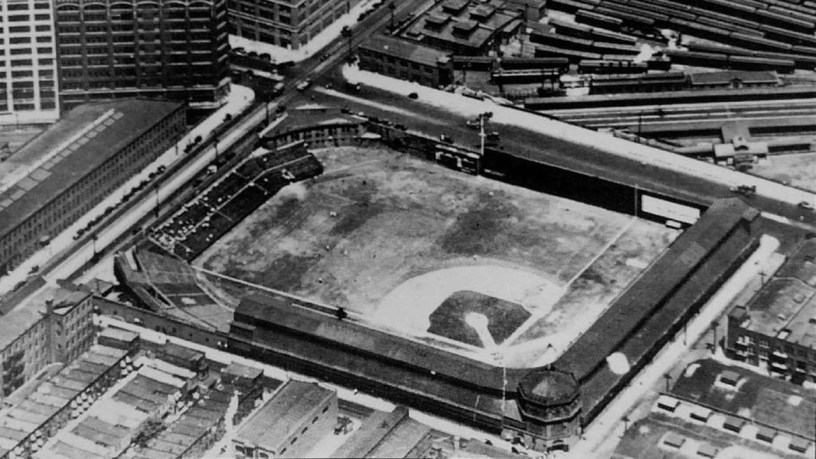
The Baker Bowl in Philadelphia was the long-time, early home of the Phillies and one of baseball’s more character filled old parks. Officially opened in 1887 as National League Park and later commonly called the Baker Bowl after owner William F. Baker, it stood at the city block bounded by North Broad Street, West Huntingdon Street, North 15th Street and West Lehigh Avenue. For more than fifty years it was the scene of everyday baseball drama, oddball quirks, and moments that still get mentioned by historians.
There were two stretches during the Baker Bowl’s existence when the Phillies had to find a temporary home field. Find out about those two stadiums at the end of the post.
Construction and architecture
The original wooden park was built for the Phillies’ 1887 season by owners Al Reach and John Rogers. That first structure burned in 1894 and was rebuilt in 1895 using steel and brick, which made it one of the earliest big-league parks constructed largely of fireproof materials. The rebuilt park was notable for its use of an early cantilevered upper deck, a forward-looking design that reduced obstructed views and influenced later ballpark construction. Over the years capacity changed with renovations, and the jagged, close-in right field wall and cramped urban parcel gave the place a compact, almost intimate feeling you wouldn’t see in modern suburban stadiums.
Set in a dense North Philadelphia neighborhood, the Baker Bowl sat across from industrial buildings and a busy rail corridor. Photographs and aerial views from the 1920s and 1930s show a modest ballpark almost hemmed in by city blocks and factories, which added to its distinct character. Fans entered from streets rather than grand plazas, and the right-field wall—short but high and filled with advertising—was a defining visual. Today the stadium itself does not survive, but a Pennsylvania historical marker and a few surrounding buildings mark the site.
Memorable moments and oddities
Baker Bowl hosted several historically interesting events. It was the Phillies’ home through eras of calamity and pride. The park saw a devastating grandstand collapse in 1903 that killed and injured fans, an episode that led to major rebuilding and scrutiny of stadium safety. In the 1910s and 1920s it staged Negro League contests and other hallmark games. Later-era lore includes Babe Ruth playing one of his last big league appearances in the city in the 1930s. The park also had quirky touches: constrained outfield dimensions, eccentric sightlines, and stories of frugal owners using unusual cost-saving measures. Those traits helped make Baker Bowl both beloved by locals and a frequent topic of nostalgia.
THE READ-IN: Stadium Week: Recreation Park (1883-1886)
By the 1930s the Phillies moved to the newer, larger Shibe Park (later Connie Mack Stadium) and played their final Baker Bowl game in 1938. The ground was used for other purposes for a time and much of the structure lingered until fires and demolition removed the remnants. The final substantial demolition took place around 1950, although pieces of the neighborhood fabric that appeared in vintage photos still stand and a formal historical marker was placed near the site to remember the ballpark. If you walk the intersection of Broad and Lehigh today you won’t see a baseball field, but you will find that the area carries echoes of the old park in building lines, city blocks, and the marker that tells the story.
Why Baker Bowl matters
Baker Bowl mattered because it represents an era when ballparks grew out of neighborhoods, when design experiments were common, and when the game’s local rhythms were shaped by the streets around the stadium. It survived fires, collapses, renovations, and changing tastes long enough to leave a strong place in Phillies lore. For fans of baseball history, a trip to the old site is a small pilgrimage. You’ll be looking at a corner of the city rather than a standing shrine, but the story of the Baker Bowl is still very much part of Philadelphia’s baseball DNA.
The other homes
Because of the 1894 fire and the collapse of part of the grandstand in 1903, the Phillies had to find other places to play ball on a temporary basis. In 1895 it was the University of Pennsylvania’s Franklin Field and in 1903 it was Columbia Park. Here’s a look at those two facilities.
The University of Pennsylvania grounds in 1894
The Phillies’ brief stay at the University of Pennsylvania in 1894 was born out of necessity rather than choice. In early May of that year, the original wooden version of National League Park, later known as the Baker Bowl, was destroyed by a massive fire. With their home gone and the season already underway, the Phillies needed an immediate temporary solution. The University of Pennsylvania allowed the team to use its athletic grounds at Franklin Field, which at that time was a relatively new and flexible facility designed to host multiple sports.
Franklin Field in 1894 looked very different from the stadium people know today. It featured simple wooden grandstands and open areas that reflected its primary use for collegiate athletics rather than professional baseball. Seating was modest, amenities were sparse, and the field dimensions were not tailored to major league play. Still, it provided a workable stopgap while the Phillies rebuilt their burned park using more fire-resistant materials.
The Phillies played roughly a month’s worth of home games at Penn, and while no single legendary baseball moment is tied to the site, the episode itself is historically important. It highlights how fragile early ballparks made of wood were and how teams relied on local institutions to survive disruptions. It also represents one of the clearer examples of major league baseball sharing space with college athletics during the game’s formative years. Once the rebuilt park on Broad Street was ready later in 1894, the Phillies moved back, ending a short but memorable chapter in the team’s early survival story.
Columbia Park in 1903
Columbia Park became the Phillies’ temporary home in 1903 after one of the darkest days in American sports history. On August 8 of that year, a portion of the Baker Bowl’s grandstand collapsed during a game, killing twelve fans and injuring dozens more. The disaster forced the immediate closure of the ballpark while repairs and safety evaluations were undertaken. With the season ongoing, the Phillies again needed a substitute venue, and Columbia Park filled that role.
Located at 29th Street and Columbia Avenue in West Philadelphia, Columbia Park was primarily known as the home of the Philadelphia Athletics before their move to Shibe Park. The park featured wooden grandstands and a more open layout than the Baker Bowl, offering better sightlines and a slightly more spacious feel. While it lacked the intimate, quirky character of the Phillies’ regular home, it was a functional major league facility that would accommodate crowds safely.
The Phillies played their remaining 1903 home games at Columbia Park, and while the circumstances were tragic, the move allowed the season to continue. The episode stands as a reminder of the risks associated with early stadium construction and the evolving understanding of crowd safety. Columbia Park itself later faded from prominence, but its role in sheltering the Phillies during a crisis gives it a lasting place in Philadelphia baseball history.
Please scroll down to comment on this story or to give it a rating. We appreciate your feedback!
Disclaimer: Some of the products featured or linked on this website may generate income for Philly Baseball News through affiliate commissions, sponsorships, or direct sales. We only promote items we believe in, but please assume that PBN may earn a cut from qualifying purchases that you make using a link on this site.
Privacy Policy | Contact us
© 2025 LV Sports Media. All rights reserved.

 Philly Baseball News