
Events in Phillies history on December 5
- December 5, 1959 — The Phillies traded pitcher Ray Semproch and shortstop Chico Fernandez to the Detroit Tigers for outfielder Ken Walters and infielders Ted Lepcio and Alex Cosmidis.
- December 5, 1978 — The Phillies signed free agent Pete Rose to a four-year, $3.225 million contract, making him at that time the highest-paid player in team sports.
- December 5, 1983 — The Phillies traded veteran reliever Ron Reed to the Chicago White Sox for a player to be named later. That player turned out to be 40-year-old left-hander Jerry Koosman.
Phillies-associated people born on December 5
- Nick Nelson (1995) — A right-handed pitcher who spent three seasons with the Phillies making two starts and 50 relief appearances with an ERA of 4.65.
- Gene Harris (1964) — A relief pitcher who pitched part of the 1995 season with the Phillies, making 21 relief appearances with a 4.26 ERA..
- Don Padgett (1911) — Catcher/outfielder who played 111 games for the Phillies in 1947–48, his final two seasons in the majors. Padgett hit .298/.349/.345/.690 with Philadelphia.
- Gus Mancuso (1905) — Veteran catcher (and later coach, scout, and broadcaster) who played the 1945 season with the Phillies.
- Billy Shindle (1860) — 19th-century third baseman who played for the Philadelphia Athletics in 1890 and then with the Philadelphia Phillies in 1891.
A DEEPER DIVE… The signing of Pete Rose
When the 1978 season ended, the Phillies were at an awkward place: they had just won the National League East for the third straight season, yet each time they fell short in the NLCS. The core of the club — veterans like Mike Schmidt, Larry Bowa and Manny Trillo — was solid. Still, the front office thought the club was missing a final piece, someone gritty and experienced, with a track record of competitive fire. That someone was Pete Rose.
As a free agent, Rose fielded offers from multiple clubs. Some were appealing in nontraditional ways: one club offered oil-investment stakes, another offered a lifetime pension, yet others dangled business opportunities or even racehorses (probably a good thing he turned that one down). The Phillies’ initial offer, by contrast, was modest: three years for about $2.1 million — by far the lowest bid Rose received.
But the Phillies had one tool the other suitors did not: a local broadcast partner. Executive vice-president Bill Giles saw an opportunity to leverage the club’s TV contract with station WPHL-TV to sweeten the deal financially, without overly burdening the payroll ledger. The Phillies had just signed an extension with WPHL, granting the station rights to broadcast roughly 75 games per year for a base fee of $1.35 million, plus a revenue-sharing clause splitting ad revenue beyond a certain threshold with the team.
Giles believed the arrival of Rose — already a national name and a former hitting champion — would significantly boost TV ratings. He proposed that WPHL-TV bump up its payment, effectively channeling the increment into Rose’s salary. The station agreed. According to their arrangement, WPHL committed to an extra $600,000 over the four-year span of the proposed contract. That infusion allowed the team to revisit Rose’s contract terms.
On December 5, 1978 — at the Winter Meetings — the Phillies unveiled the final agreement: a four-year deal worth approximately $3.2 million (about $800,000 per year). That made Rose the highest-paid player in baseball at the time.
Beyond the money, the Phillies made a pitch about opportunity: Rose had spent his entire 16-year career in Cincinnati, and by coming to Philadelphia he would continue to chase history; the National League’s all-time hits record. Team leadership subtly pointed out that signing with an American League club would foreclose that possibility. That argument reportedly resonated with Rose and his agent.
Why the TV contract mattered
The arrangement with WPHL-TV was more than a clever accounting trick. It reflected a changing business landscape in baseball, where television revenue would directly influence player payrolls. For the Phillies, the deal offered a win-win: the station got a bigger star to draw viewers and advertisers, the club gained the ability to pay top dollar without altering its underlying finances, and Rose got the long-term security he sought. According to team records, ticket sales spiked after the signing — the Phillies reportedly sold around three million dollars’ worth of tickets in the first 30 days after the deal.
The mechanism also demonstrated how media exposure and local broadcast economics were beginning to reshape roster construction. In effect, the channel became a quasi-sponsor of Rose’s salary. Without that cooperation from WPHL-TV, the Phillies’ front office would have had a tough time justifying the four-year, $3.24 million contract.
The impact and legacy
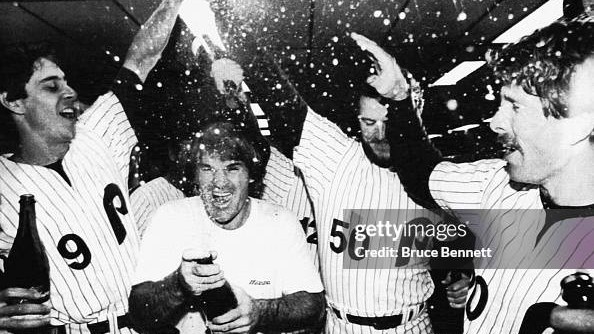
When Rose finally joined the Phillies in spring 1979, he shifted to first base — the team’s third baseman, Mike Schmidt, was not budging. His rookie Phillies season didn’t yield a postseason berth, but the club remained strong. Two years later, in 1980, the Phillies captured their first World Series championship. Rose, at age 39, was part of that title team, and over the next few seasons the Phillies would return to the Series in 1983.
Hindsight suggests that Rose was the defining free-agent signing in Phillies history. The gamble paid off: on the field, his hustle, experience, and clutch hitting helped complete a roster built on talented core players. Off the field, his presence gave rise to a template for how teams would begin to use media revenue to fund big contracts. Observers later described it as “the wildest auction in baseball history.”
In the long view, the 1978 signing of Pete Rose stands as a turning point for the Phillies — not only because it filled a roster need, but also because it marked a shift in how baseball teams valued and leveraged television relationships. The WPHL-TV deal helped transform the club from a contender into a champion, and that December decision echoed far beyond the 1978 Winter Meetings. Maybe the Phillies should be talking to NBC Sports Philadelphia going into this year’s Winter Meetings about Kyle Schwarber.

 Philly Baseball News