
Events on December 4 (involving the Phillies):
- December 4, 1959 – Catcher Carl Sawatski was traded by the Philadelphia Phillies to the St. Louis Cardinals in exchange for Bobby Smith and Bill Smith.
- December 4, 1998 – The Phillies signed international free agent Carlos Ruiz out of Panama. Ruiz went on to play over 1,000 games with the Phillies hitting .266/.352/.393/.745 over 11 seasons. He also played in 14 games with the Dodgers in 2016 and 53 games with Seattle in 2017.
People associated with the Phillies born on December 4:
- Jake Cave (1992) Cave played in 65 games for the 2023 Phillies and slashed .212/.272/.348/.620.
- Jerome Williams (1981) A first round draft pick of the Giants in 1999, Williams made 30 starts and 12 relief appearances for the Phillies in 2014 and 2015, going 8-14, 4.84.
- Harvey Kuenn (1930) Kuenn collected over 2,000 hits prior to finishing his career playing in 86 games for the Phillies in 1966 after having his contract purchased from the Chicago Cubs.
- Tadahito Iguchi (1974) Played in 45 games and hit .304 with the Phillies in 2007 and was released following the season and signed with San Diego. The Padres released him on September 1, 2008 and the Phillies re-signed him for the rest of the season, which was his last in the majors. He played in just 4 games and went 2-for-7 (.286).
A DEEPER DIVE… Harvey Kuenn
Harvey Kuenn’s baseball career is one of the more interesting arcs in mid-20th-century Major League Baseball, marked by early stardom, remarkable consistency, and a late-career transition that helped define his legacy. Born in 1930, Kuenn emerged as a premier contact hitter during the 1950s and early 1960s, known for his ability to put the ball in play, spray line drives to all fields, and handle pressure at the plate. His story is often framed by a blend of impressive achievements, resilience, and a reputation as one of the game’s most reliable professionals.
Kuenn debuted with the Detroit Tigers in 1952 and immediately established himself as one of the American League’s best hitters. He won the AL Rookie of the Year Award in 1953 and went on to become an eight-time All-Star during his years in Detroit. His skill set was rooted in exceptional bat control rather than power. Kuenn regularly hit for a high average, topping 190 hits seven times and finishing with a career batting average of .303. His best season came in 1959, when he won the American League batting title with a .353 mark. Despite not being a classic power hitter, he was a consistent run producer thanks to his knack for reaching base and moving runners along.
One of the most memorable moments in baseball history involved Kuenn indirectly: the famous 1960 trade between the Tigers and Cleveland Indians that sent Kuenn to Cleveland in exchange for Rocky Colavito. At the time, Colavito was one of the league’s premier power hitters, while Kuenn was the reigning batting champion. The swap generated enormous controversy—Cleveland fans were furious about losing Colavito—but Kuenn continued to hit well. The trade has since become one of baseball’s most analyzed deals, often cited for the contrast in player types and the emotional reaction it sparked.
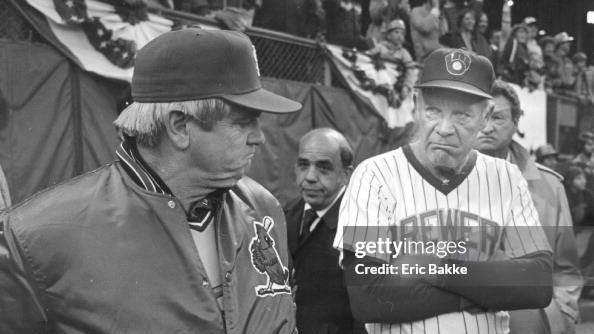
Kuenn’s playing career took him through several teams, including stints with the Giants and Cubs, before he finished with the Phillies in 1966. His time in Philadelphia was brief, but it capped a career that totaled more than 2,000 hits and nearly 1,000 runs scored. Even late in his career, Kuenn brought clubhouse leadership and a veteran presence valued by younger players. After retiring as a player, he remained active in baseball, eventually becoming a coach and later the manager of the Milwaukee Brewers.
As a manager, Kuenn became best known for leading the 1982 Brewers—nicknamed “Harvey’s Wallbangers”—to the American League pennant. That team, built around heavy hitters like Robin Yount, Paul Molitor, and Cecil Cooper, embraced a free-swinging, power-driven style that perfectly matched Kuenn’s relaxed leadership approach. The Brewers reached the World Series, where they lost to the St. Louis Cardinals, but their run remains one of the most beloved eras in Brewers history.
Harvey Kuenn’s legacy spans both playing and managing, defined by professionalism, offensive skill, and a genuine rapport with teammates and players. He remains remembered as one of baseball’s quintessential hitters—a player who rarely sought attention yet consistently found his way into the game’s defining moments.

 Philly Baseball News