
Events of November 26 in Phillies history
- November 26, 1909 — the Philadelphia Phillies were sold for $350,000 to a syndicate headed by sportswriter Horace Fogel. Fogel became the club’s president. The change of ownership marked the beginning of a controversial era: Fogel would later be banned from baseball for his charges against umpires and accusations of a fixed pennant race.
Members of the Phillies family born on November 26
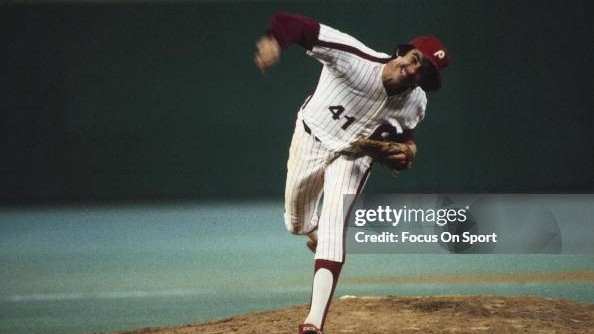
- Bob Walk (1956) – He pitched for the Phillies as a rookie in 1980, going 11–7 and earning the win in Game One of the 1980 World Series.
- Garton del Savio (1913) – del Savio appeared in four games for the Phillies in 1943, collecting one hit in 11 at bats. Those four games were the only MLB games he appeared in as a major league player.
- Hugh Duffy (1866) – A Hall of Famer as a player, he later managed the Phillies from 1904 through 1906 and helped guide the team through a transitional period in franchise history.
- Richie Hebner (1947) – A longtime big-league third baseman, he played for the Phillies in 1977 and 1978, providing power and veteran steadiness during the club’s late-70s contention window.
A DEEPER DIVE… Richie Hebner
Richie Hebner was one of the more colorful and steady corner infielders of the 1970s and early 1980s. Known for his strong personality, his background as an offseason gravedigger, and his ability to deliver consistent production, Hebner carved out an impressive 18-year major league career. Most fans remember him for his long run with the Pittsburgh Pirates, but his time with the Phillies played an important role in both his story and the franchise’s rise during a competitive era.
Hebner arrived in professional baseball as a first-round draft pick by the Pirates in 1966, and he moved quickly through their system thanks to a polished left-handed swing. By 1969 he was Pittsburgh’s regular third baseman at just 21 years old. He grew into a dependable hitter known for working counts, driving the ball, and contributing in the middle of the order without needing to be the lineup’s star. During his years with the Pirates he played in multiple postseason series, including the 1971 World Series won by Pittsburgh. Those early seasons defined him as a gritty player with a reliable bat and an ability to perform in pressure spots.
By the late 1970s, the Phillies were assembling a talented and veteran roster built around Mike Schmidt, Greg Luzinski, Larry Bowa, and a strong pitching staff. After auditioning several players to fill the hole at first base, the organization believed it needed a stabilizing presence at the position. That led to the signing of Hebner before the 1977 season. Even though he had spent most of his career at third, the Phillies already had a Hall of Famer at that position, so Hebner shifted across the diamond and took on the challenge with the professionalism he was known for.
Hebner’s first season in Philadelphia was one of the best of his career. He delivered consistent offense, drove in runs, and gave the Phillies a left-handed presence that balanced their lineup. The 1977 Phillies won 101 games and captured the National League East title with Hebner’s contributions as a key part of that success. He also blended well with the club’s veterans, though his honest and sometimes blunt nature made him a noticeable figure in the clubhouse. That first year showed why Philadelphia targeted him. He provided both dependability and toughness, two qualities the team valued as it tried to break through to a World Series.
The 1978 campaign brought similar results. Hebner remained consistent at the plate and helped the Phillies win another division title. The team again fell short in the National League Championship Series, but Hebner continued to be viewed as a steady part of a very strong roster. His ability to play both corner infield spots also gave the club some flexibility, though first base was clearly his home during his Philadelphia stint.
After the 1978 season, the Phillies decided to move in a different direction. The emergence of first baseman Pete Rose as a free agent target and the club’s desire to reshape parts of its lineup led to Hebner being traded to the Mets in a multi-player deal. Though his stay in Philadelphia lasted only two seasons, it came during a period of high expectations and helped the Phillies solidify their lineup during back-to-back postseason runs.
Hebner continued his career with the Mets, Tigers, Pirates again, and Cubs, remaining a productive role player well into the early 1980s. His final major league season came in 1985, closing out a long and steady run marked by competitive teams, reliable offensive output, and a unique personality that fans remembered long after he retired.
In Philadelphia, his time was brief, but he played an important part in a critical chapter of the franchise’s history. His solid bat and veteran presence contributed to a pair of division-winning seasons and added depth during a period that laid the groundwork for the Phillies’ eventual championship in 1980.
Remember to scroll down to leave your comments on this story. Perhaps give your recollections of the players mentioned in this post or just talk about baseball.
Please scroll down to comment on this story or to give it a rating. We appreciate your feedback!
Disclaimer: Some of the products featured or linked on this website may generate income for Philly Baseball News through affiliate commissions, sponsorships, or direct sales. We only promote items we believe in, but please assume that PBN may earn a cut from qualifying purchases that you make using a link on this site.
Privacy Policy | Contact us
© 2025 LV Sports Media. All rights reserved.

 Philly Baseball News