
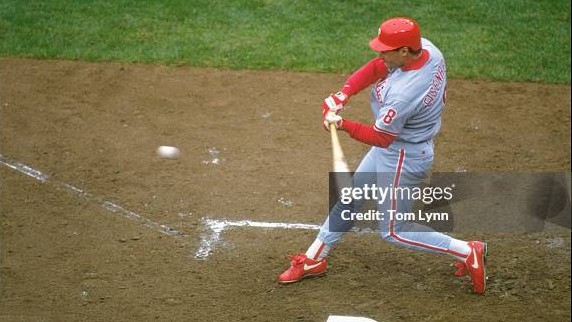
Phillies Events of November 24
- 1993 – The Phillies re-signed free agent outfielder Jim Eisenreich to a one-year deal.
- 2002 – The Phillies signed third baseman David Bell to a four-year, $17-million free agent contract. On that same date, they also re-signed pitcher Amaury Telemaco as a minor league free agent.
Phillies People Born on November 24
- George Burns (born 1889) – Not the comedian, the outfielder who played for the Phillies in 1925, his final season in a 15-year career. In 88 games he hit .292 with Philadelphia.
- Juan Villavicencio (born 2004) — A shortstop in the Phillies’ minor-league system who played 26 games for Clearwater in 2025 and hit just .146. Villavicencio was signed from Venezuela in 2022.
A DEEPER DIVE… Jim Eisenreich
Jim Eisenreich’s career is one of the more inspiring and quietly impactful journeys in modern baseball history. He entered the majors in the early 1980s with the Minnesota Twins, where his potential was obvious but his ability to stay on the field was disrupted by symptoms no one yet fully understood. Eisenreich had undiagnosed Tourette’s syndrome at the time, and the physical and vocal tics associated with the disorder often intensified in high-stress situations. The ballpark environment made those symptoms even more difficult to control. Early in his career, he would sometimes have to remove himself from games, and at one point he stepped away from baseball entirely to focus on his health and get a clearer understanding of what he was actually dealing with.
Once properly diagnosed, he began receiving treatment and support that allowed him to regain control of his career. By the late 1980s and early 1990s he had rebuilt himself into a dependable and highly professional hitter, first with Kansas City and then with Philadelphia. His years with the Royals established him as a player who hit for a strong average, played all three outfield positions smoothly, and brought a steady presence to a clubhouse.
When the Phillies signed him before the 1993 season, the move didn’t generate big headlines, but it ended up being one of the smartest complementary additions the team made. The 1993 Phillies were known for their larger-than-life personalities, but Eisenreich was the opposite. He brought a calm, grounded approach and a consistent contact bat that helped balance the lineup. He hit .318 that season, provided quality at-bats from the corner outfield and designated hitter spots, and delivered several big moments on the way to the National League pennant. Fans quickly took to him because he played hard, made the most of his opportunities, and never seemed fazed by pressure situations.
Eisenreich’s role on that team went beyond his numbers. His perseverance and quiet leadership resonated in a clubhouse full of Type-A personalities. While others drew more attention, he simply performed. In the World Series, he hit a memorable home run off Jack Morris in Game 2, a moment that remains part of Phillies postseason lore. Even after 1993, he continued to be a reliable bat for Philadelphia. He stayed productive through the mid-1990s and remained a valued part of the roster until he moved on to Florida and then Los Angeles later in his career.
Beyond baseball success, Eisenreich became well known for his advocacy surrounding Tourette’s syndrome. Once he went public with his diagnosis, he committed himself to speaking openly about the condition and helping families understand it. He and his wife founded the Jim Eisenreich Foundation for Children with Tourette Syndrome, an organization dedicated to supporting kids who struggle with the same challenges he faced. His willingness to talk about what the disorder actually feels like and how it affects everyday life helped reduce stigma at a time when Tourette’s was widely misunderstood.
What made his story even more meaningful was how openly he described the darkest moments of his early playing days. He talked about panic, confusion, and the fear of not knowing why his body responded the way it did. Once he learned how to manage the condition, he not only revived his career but flourished in it. That journey made him an easy player to root for, not just in Philadelphia but across the league.
Today, Eisenreich is remembered in Philadelphia as a key contributor to one of the franchise’s most beloved teams and as someone whose resilience and humanity left a lasting impression. His time with the Phillies showcased his skill on the field, but his larger legacy is defined by his openness, his advocacy, and the way he used his platform to help others facing challenges similar to his own.

 Philly Baseball News