
Philadelphia Phillies – Notable Events on November 23
- 1943 – Commissioner Kenesaw Mountain Landis permanently banned Phillies owner William D. Cox for betting on his own team. The decision forced the franchise into new ownership and closed one of the most controversial moments in team history. That new ownership, the Carpenter Family, took over on that same day, beginning a long period of stability that helped reshape the franchise from top to bottom.
- 1964 – General manager John Quinn extended manager Gene Mauch for two more years. It reinforced the front office’s commitment to Mauch’s leadership despite the heartbreak of the 1964 season.
Phillies Players, Managers, Executives, and Broadcasters Born on November 23
- Jonathan Papelbon (born 1980) – Phillies closer from 2012 to 2015. He set the franchise saves record during his tenure and remained one of the more dominant late-inning arms of his era.
- Casper Wells (born 1984) – Outfielder who spent a brief stint with the Phillies in 2013, playing in just 12 games and hitting .042 (1-for-24). Known mostly as a journeyman outfielder, Wells also played for Seattle, Detroit, the Chicago White Sox, and Oakland.
- Adam Eaton (born 1977) – Right-handed pitcher who spent 2007–2008 with the Phillies. Though his tenure was uneven at best – 14-18, 6.10 – he was part of the organization during the early stages of the team’s ascent to its 2008 championship. The Phillies released him in February of 2009, still owing him $9-million from a three-year, $24.5-million contract he signed prior to 2007.
- Bubber Jonnard (born 1897) – Catcher who played for the Phillies in the early 1920s. After his playing career, he became well-known in baseball circles as a respected scout and instructor.
A DEEPER DIVE… The Carpenter Family
The Carpenter family’s involvement began in 1943, when R. R. M. Carpenter Sr., a Du Pont executive, bought the Phillies for around $400,000. His purchase brought much-needed financial stability to a franchise that had cycled through owners and was frequently undercapitalized. From the start, the Carpenters set a long-term vision: not just to prop up the team, but to build a sustainable, competitive organization.
Under Carpenter Sr., the Phillies began investing in their farm system, setting the foundation for future success. He also brought in Herb Pennock as the team’s first modern general manager, giving the front office structure that had been missing before. Over time this led to a core of talented young players like Richie Ashburn and Robin Roberts, who helped the team win the National League pennant in 1950 as part of the “Whiz Kids” era.
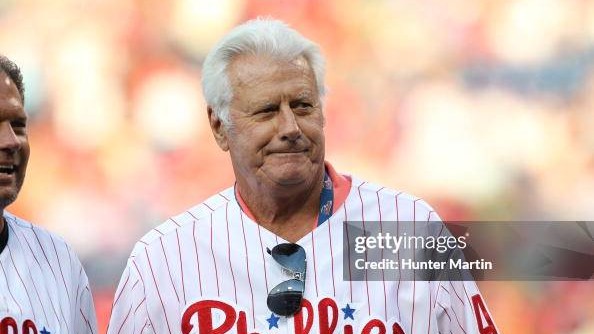
Ruly Carpenter’s Era
Bob “Ruly” Carpenter III, grandson of Carpenter Sr., assumed the club’s presidency in 1972 at just 32 years old, making him the youngest MLB team president at the time. From the outset, Ruly’s philosophy emphasized building from within. He advocated for and convinced his father to hire Paul Owens to run the farm system, an act that would prove pivotal.
Through the late 1970s, under Carpenter’s leadership, the Phillies developed a core of homegrown talent: Mike Schmidt, Larry Bowa, Greg Luzinski, Bob Boone and others, thanks to a strong player development pipeline. These players helped power the Phillies to three straight National League East division titles from 1976 to 1978.
One of the crowning achievements of the Carpenter era arrived in 1980, when the Phillies won their first World Series. That championship was the realization of a long-term plan: invest in young talent, promote from the farm system, and pair smart management with stability from the top. Carpenter promoted Dallas Green as manager and leaned on Owens in the front office to build a championship roster.
Philosophy and Legacy
Ruly Carpenter was known for his personal touch. Alumni and former players remembered him as more than an owner — someone who would walk into the clubhouse, pull up a chair, and talk baseball. He had a genuine passion for developing not just players, but front-office talent. He put faith in Owens, and together with Green, they created a franchise identity rooted in disciplined scouting, player development, and continuity.
His leadership was marked by consistency. During his nine years as president, the Phillies posted a 763-640 record. That stability fostered trust between players and management — many referred to him more as a teammate than a traditional owner.
Challenges and Decision to Sell
Despite the on-field success, Carpenter grew increasingly uneasy with the changing economics of baseball. By the early 1980s, the era of free agency was in full swing. Salaries were escalating, and Carpenter publicly expressed concern that his family business would not sustain the financial demands required to keep the team competitive. At the time of the World Series title, the Phillies’ payroll was among the highest in the league.
In spring 1981, just as Spring Training was beginning in Clearwater, Carpenter called a meeting with the players and executives and announced that the family was putting the team up for sale. The decision surprised many — the team was riding high, but Carpenter felt that the long-term financial burden and the pressure of keeping up with rising player pay was unsustainable for his family’s business model.
Sale to Current Ownership
Later in 1981, the Phillies were sold to a group led by longtime Phillies executive Bill Giles for approximately $30–32.5 million. Giles, who had served under the Carpenters, brought in a broader ownership group and a new chapter began. While the Carpenters stepped aside, their legacy was far from forgotten: they left behind a stronger franchise, a robust farm system, and a championship culture.
Over the decades since, the team passed through different ownership structures but the stability that the Carpenters established allowed later regimes to continue building. Their patient and principled stewardship is still widely credited for creating the foundation of modern Phillies success.
In summary, the Carpenter family’s nearly four decades of ownership reshaped the Phillies from a struggling franchise into a championship organization. They rebuilt the minor-league system, cultivated star players, and delivered Philadelphia its first World Series title. Their decision to sell, though driven by financial realism in a changing game, ensured that the Phillies would continue under new leadership, but their influence remains a defining chapter in the club’s history.

 Philly Baseball News