
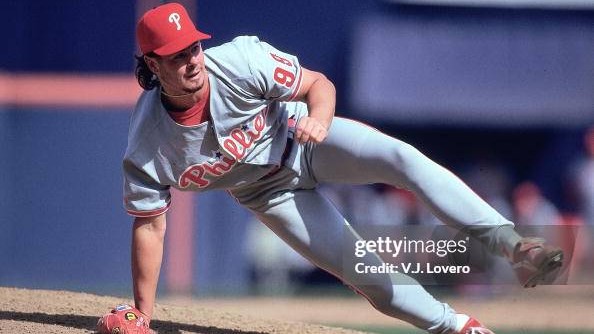
Events in Phillies history on November 17
- November 17, 1981: Phillies third baseman Mike Schmidt won his second consecutive National League MVP Award.
- November 17, 1992: The Phillies acquired left-handed pitcher Danny Jackson from the Florida Marlins in a trade that sent Joel Adamson and Matt Whisenant to Florida.
Phillies players, managers, executives, and broadcasters born on November 17
- Mitch “Wild Thing” Williams (1964) — “Mitchy Poo” as Harry Kalas called him, was a relief pitcher for the Phillies from 1991 to 1993 and is well known for his high-velocity fastball and wildness.
- Ty Taubenheim (1982) – Taubenheim is a right-handed pitcher who signed a minor-league contract with the Phillies on March 31, 2010, and was assigned to Reading and Lehigh Valley during that stint in the Phillies system. Wikipedia
- Billy McMillon (1971) – McMillon is a former outfielder who was traded to the Phillies in July 1997 and appeared in 24 games for the Phillies that season. After his playing career he moved into coaching and managing in the minors.
- Valentino (Val) Pascucci (1978) – Pascucci signed a minor-league contract with the Phillies in December 2007 and spent time with the Lehigh Valley IronPigs (Triple-A) in the Phillies’ system before moving on. He played in 32 games with the Montreal Expos in 2004 and didn’t return to the majors until playing 10 games with the New York Mets in 2011.
A DEEPER DIVE… Mitch Williams
Mitch Williams carved out one of the more memorable careers of any late-inning reliever of his era, thanks to a combination of big-game performances, a fierce competitive streak, and a reputation for living on the edge every time he took the mound. Known widely as “Wild Thing,” Williams became a folk hero in Philadelphia during the early 1990s, even as his unpredictability kept fans on edge during nearly every appearance. His delivery was violent and unorthodox, featuring a dramatic fall toward first base, and his fastball came in hard but not always where he intended. That combination made him both exhilarating and nerve-wracking to watch.
Williams broke into the majors with the Texas Rangers in 1986 and quickly displayed the talent that would define his career. His walk rate was high even then, but his ability to miss bats and pitch fearlessly in high-leverage spots made him valuable. A 1988 trade sent him to the Chicago Cubs, where he became even more well known. His 1989 season with Chicago was one of the best of his career; he saved 36 games, made the All-Star team, and helped the Cubs reach the postseason. During that playoff run, he threw in all five games of the National League Championship Series against the Giants. Even as the Cubs fell short, his intensity and willingness to take the ball made an impression.
The Phillies acquired Williams prior to the 1991 season for pitchers Chuck McElroy and Bob Scanlan, and Philadelphia quickly embraced him. He fit perfectly with the gritty style and personality of the club, particularly the group that would come to define the 1993 team. In 1991, he posted a 3.78 ERA with 30 saves, then followed with 29 saves in 1992. His outings were never boring. Walks, strikeouts, and drama were part of the package, but he usually found a way to escape.
The 1993 Phillies were an unforgettable group—loud, tough, and full of personalities—and Williams was at the center of it. That year, he saved 43 games and helped stabilize the bullpen for a team that shocked the league by winning the National League pennant. His workload – 65 games – was heavy and his style continued to be heart-stopping, but he came through repeatedly during the regular season and again in the National League Championship Series win over Atlanta.
One of the most famous images from that postseason involved Curt Schilling, who put a towel over his head whenever Williams entered a game. Schilling was the Phillies’ Game 5 starter in the NLCS and returned to the dugout after his outing. When Williams came in to close, Schilling draped a towel over his face rather than watch. The moment became an instant talking point, with fans reading it as a sign of Schilling’s nervousness about how unpredictable Williams could be in big moments. Williams later said he understood the humor and never took it personally. The two remained teammates, and the towel incident became one of the enduring snapshots of that 1993 run.
Of course, Williams’ time in Philadelphia is often remembered for one difficult moment. In Game 6 of the 1993 World Series, he gave up the season-ending three-run home run to Joe Carter of the Blue Jays. The pitch will forever be part of baseball history, but it overshadowed how vital Williams had been in getting the Phillies to that point. After the season, Williams was traded to Houston. He later pitched for California and Kansas City but never regained his previous form, saving just six games over his final three seasons.
After retiring, Williams transitioned into broadcasting, including a stint with MLB Network. His personality translated well to television, and he remained a recognizable figure among fans. The ups and downs of his career made him a compelling character, and the passion he brought to the game continues to define how people remember him. Despite one moment that looms over his legacy, Mitch Williams’ career was full of achievement, emotion, and intensity, and his impact on Philadelphia baseball remains significant.

 Philly Baseball News