
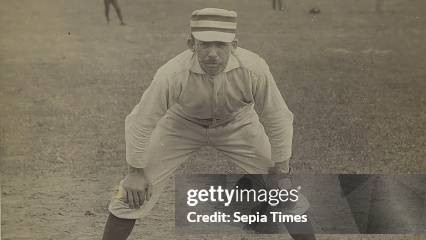
Phillies Events of November 15
- November 15, 1933: The St. Louis Cardinals traded catcher/manager Jimmie Wilson to the Phillies in exchange for Spud Davis and Eddie Delker. Wilson became the Phillies’ player-manager for several seasons.
- November 15, 2016: The Phillies released Matt Harrison, a pitcher acquired in the 2015 Cole Hamels trade, without ever having him throw a pitch in a Phillies uniform. Harrison actually never pitched in the majors after the trade because of a series of back surgeries that were not successful in helping a chronic back condition.
Phillies-Associated People Born on November 15
- Orlando Gonzalez (1951). He was a first baseman/outfielder who played for the Phillies in 1978, hitting .192 with 27 plate appearances in 26 games with the Phillies.
- Thompson Orville “Mickey” Livingston (1914). He was a catcher who played for the Phillies in 1941 and ’42, hitting .221 in 268 games in Philadelphia.
A DEEPER DIVE… Player-Managers in Phillies history
From the early days, the Phillies (then the Quakers) leaned on the model of having a playing skipper. Their first-ever manager, Bob Ferguson, doubled as a second baseman in 1883. It didn’t go smoothly — he was fired after just 17 games, when his team was 4–13. Ferguson was known for his fiery personality, but his approach didn’t yield results.
He was succeeded that season by Blondie Purcell, a veteran outfielder and pitcher. Purcell became player-manager partway through the ’83 campaign, but the team struggled mightily under his watch as well, going 13–68. That remains one of the worst managerial records in franchise history.
Through the 1890s, the Phillies continued to use player-managers. Jack Clements, a lefty-throwing catcher from Philadelphia, filled in as manager in 1890 when Harry Wright had to step away; he posted a decent 13–6 record. Not long after, Bob Allen, a rookie shortstop, also took the reins when Wright was absent, guiding the club to a 25–10 record.
In the mid-1890s, Arthur Irwin, who had played shortstop for the Phillies, became player-manager, mostly in a nominal sense since he only played in one inning during his managerial stretch. Then came Billy Nash, a third baseman who ended his long playing career by managing in 1896 while still appearing in games occasionally.
In 1897, George Stallings took the helm. He also barely played while managing, appearing only in a couple of games, but he’s counted among the Phillies’ player-managers because he was still technically on the roster.
Moving into the 20th century, Charles “Chief” Zimmer, a veteran catcher, became player-manager in 1903. He played 37 games behind the plate while leading the team, but his season only yielded a 49–86 record. Hugh Duffy, a former star outfielder, took over as player-manager from 1904 to 1906. And like many of his predecessors, played sparingly during his tenure and had mixed success: the Phillies finished as low as eighth and as high as fourth under his watch.
In the 1910s, Red Dooin, a long-time Phillies catcher, served as player-manager for five seasons (1910–1914). Over that stretch, his record was 392–370, which is respectable. Dooin is known for being a player’s manager who was at least able to keep things stable, if not spectacular. Then, Gavy Cravath, one of the power hitters of his era, became player-manager in 1919 and 1920. Known primarily as a slugger, he compiled a 91–137 managerial record, while still producing at the plate to the tune of 13-56-.332/.433/.610/1.043 in 129 games. Those two seasons as a player-manager were Cravath’s final MLB seasons.
In the early 1920s, Irvin “Kaiser” Wilhelm, a pitcher, became player-manager in 1921. He only tossed a few games his final season, and as manager, he went 83–137. Then in 1927, Stuffy McInnis, a longtime first baseman, served as player-manager, though he only appeared in one game that year as a player, and the team went 51–103.
Perhaps the most notable mid-century player-manager was Jimmie Wilson, a Philadelphia native and catcher. He returned to the Phillies as player-manager in 1934 and held that role through 1938. Unfortunately, the team was not good under him — he posted a 280–477 record and several last-place finishes.
Finally, Ben Chapman had a brief stint as a player-manager in 1945–46. Chapman, who had a long career as a player, made a few relief appearances while managing, but his teams struggled during his tenure. He continued on as the team’s manager after his playing days were over, managing the team in 1947 and for the first half of the 1948 season until he was fired with the team holding a 37-42 record. One of the reasons leading to Chapman’s firing was his propensity for yelling racial epithets at Jackie Robinson and for being outspoken about blacks not belonging on MLB teams.
Who was most successful (and who wasn’t)?
Given how few of those player-managers had winning records, success was hard to come by. Among those early player-managers, Arthur Irwin stands out: in two seasons (1894–95) he posted very solid winning percentages (71–57, then 78–53). His relatively short playing involvement and adept managerial hand make him arguably the most effective multi-tasker in Phillies history.
On the flip side, Blondie Purcell had the worst single-season mark, and Jimmie Wilson, despite his long tenure, never managed a winning team. Their records reflect how difficult it was to balance playing and managing, especially in lean years.
Why did player-managers fade away?
By the time the 1930s and especially later decades rolled around, the demands of managing grew, and rosters expanded. The dual role became less sustainable. The Phillies’ history mirrors that of the rest of baseball; as the game professionalized, it became rare to see someone both play and manage. By the mid-20th century, most managers were full-time, off-field bosses.

 Philly Baseball News