
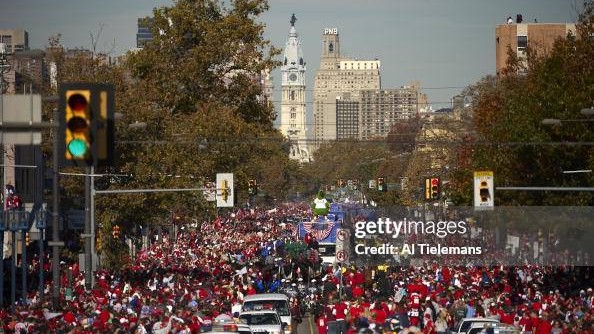
It may have been the biggest Halloween Parade in history! The Phillies and their fans turned Broad Street into an absolute celebration venue to celebrate the team’s 2008 World Series championship. Plus, Halloween brings memories of a 1972 trade that sent a baseball lifer to Milwaukee. In our Deeper Dive segment we take a look at Phillies player, coach, interim manager, and front office executive John Vukovich.
Philadelphia Phillies events that occurred on October 31
- 2008 World Series victory parade in Philadelphia — The Phillies held their championship parade on Broad Street on October 31, 2008, celebrating the franchise’s second World Series title with a citywide parade and rally at Citizens Bank Park.
- Seven-player trade with the Milwaukee Brewers (1972) — On October 31, 1972, the Phillies traded Don Money, Bill Champion, and John Vukovich to the Milwaukee Brewers in exchange for Ken Brett, Jim Lonborg, Ken Sanders, and Earl Stephenson; the multi-player swap reshaped both clubs’ rosters and saw Vukovich eventually return to Philadelphia later in his career.
Phillies players, managers, executives, and broadcasters born on October 31
- Hardie Henderson (1862) — Born October 31, 1862 in Philadelphia, Henderson pitched in the major leagues from 1883–1888 and made his National League debut with the Philadelphia Quakers in 1883, placing him on the very first Phillies-era major league roster.
- David Dellucci (1973) — Born October 31, 1973 in Baton Rouge, Dellucci was a left-handed outfielder who played 13 MLB seasons and was with the Phillies during the 2006 season after being acquired that year.
A DEEPER DIVE… John Vukovich — a Philadelphia baseball lifer
John Vukovich’s story is one of those baseball lives that is less about gaudy statistics and more about relentless work, loyalty, and the small, human moments that bind a franchise to its fans. A first-round pick of the Phillies in 1966, Vukovich climbed the minors the old-fashioned way and made his big-league debut with Philadelphia in September 1970. He never became a star with the bat, but he carved out a role as a gritty, reliable glove-first infielder and earned the kind of respect that lasts far longer than box-score lines.
Vukovich’s playing résumé looks modest on paper. His lifetime batting average was just .161 and he only hit six career home runs. What doesn’t show up in the numbers is how his teammates and fans valued him. He was the quintessential utility player, the type of teammate who would give everything in a ninth-inning defensive stand and who lingered in the clubhouse long after the game to help younger players. That reputation led to long friendships and ultimately to a second life with the Phillies as a coach and mentor.
The October 31, 1972 trade and the middle years
On October 31, 1972, Vukovich was part of a big seven-player deal that sent him, Don Money, and Bill Champion from the Phillies to the Milwaukee Brewers in exchange for Jim Lonborg, Ken Brett, Ken Sanders, and Earl Stephenson. The trade was one of those roster shakes that reshaped both clubs’ depth charts and sent Vukovich into a new phase of his playing career. He spent the 1973–74 seasons in Milwaukee, then moved briefly to Cincinnati before making his way back to Philadelphia for the second half of his career.
That October 31 trade deserves emphasis because it interrupted Vukovich’s early bond with the Phillies, only to set the stage for a comeback that cemented his identity with Philadelphia. He didn’t love being traded at first, but the Brewers saw him as a versatile utility piece and he embraced the role. Over the next few seasons he bounced around, including a brief stint with the Reds, where he was part of the 1975 organization before being returned to the Phillies later that year. The rolls and returns of those years made his eventual long-term return to Philadelphia feel earned, not given.
Return to Philadelphia, on the field and in the dugout
When Vukovich returned to the Phillies in the mid-to-late 1970s, his value was increasingly intangible but no less real. He was an infielder who understood positioning and fundamentals, and managers relied on him to shore up late-inning defense and to steady a bench. By temperament and by approach he fit the old-school Philly mold: blunt, hardworking, and intolerant of sloppy play. That demeanor could be abrasive to some players, but it was exactly what many others needed to get better.
After he hung up his spikes as a player in the early 1980s, Vukovich transitioned into coaching. He spent time on the Cubs’ staff before returning to Philadelphia in 1988, where he became a fixture of the Phillies coaching corps for the next 17 seasons. As a coach, he developed a reputation as a fierce instructor who was especially valued by pitchers and defensive players. He was the kind of coach who prepared starting pitchers by going over every hitter in the lineup and who would not shrink from telling a veteran what he needed to hear to improve. Players learned to trust that his bluntness came from a place of wanting the best for the team.
Vukovich’s coaching tenure with the Phillies coincided with some of the franchise’s most meaningful years. He was on staff for long stretches, including periods when the club contended and when it rebuilt. His presence was steady; his voice in the clubhouse became part of the team’s identity. He was also briefly the interim manager in 1988 after Lee Elia’s firing, a short stint that highlighted how ingrained he was in the organization’s daily operations and decision-making processes.
The Davis Schneider glove story and a small-world baseball moment
One of the oddest and most charming postscript moments to Vukovich’s life came decades after his playing days in the form of a lost-and-found glove. In 2023, a young Toronto Blue Jays player named Davis Schneider began using an old Mizuno glove he had found in the lost-and-found at his offseason training facility. The glove had the letters “VUK” written on it, a curious bit of graffiti that caught people’s attention when a photo surfaced on social media.
The glove turned out to have belonged to John Vukovich. The connection was revealed when Vukovich’s son, Vince, recognized the glove in the social posts and reached out. The coincidence grew stranger because Vince had been college roommates and teammates at Delaware with John Schneider, who years later became the Blue Jays’ manager. That meant the glove owned by a late Phillies coach had somehow ended up in the hands of a young player for a team managed by his father’s old college roommate. Vince jokingly texted John Schneider to ask for the glove back, and the story became a small delight for fans who love baseball’s improbable links.
That anecdote captures a lot about Vukovich’s life and how his influence traveled. It shows how small gestures and artifacts — a name scrawled on the leather of a well-worn mitt — can bridge generations. It also underlines the network of relationships that runs through baseball, where a college friendship can pop up decades later in the most unexpected place. For Vukovich’s family and for fans, seeing his initials on a glove used in the majors again was a bittersweet reminder of his long reach and the straightforward kind of legacy he left behind.
Illness, front office role, and legacy
Vukovich faced a serious health battle beginning in 2001 when he was diagnosed with a brain tumor. He underwent surgery and showed the same grit in his recovery that he had shown on the field. He returned to the bench later that year and remained on the coaching staff until 2004. After the 2004 season the Phillies moved him into a front office role as a special assistant to the general manager. His illness returned in 2006 and he passed away in March 2007. The club honored him with a uniform patch and countless remembrances from players, broadcasters, and fans who remembered him not for headline-grabbing plays but for the lasting imprint he left on a franchise and its people.
The mark Vukovich left on Philadelphia baseball is about loyalty and craft. He went to the World Series as both a player and a coach, and that unique pairing of roles made him part of the Phillies’ connective tissue across generations. He is often recalled in the same breath as beloved Philly figures because he spent decades teaching the next wave of players what it meant to be a Phillie.
Why Vukovich still matters
John Vukovich may not appear on leaderboards for home runs or batting average, but his importance to the Phillies is easy to see in the stories players tell about him. He was the coach who would tell you the truth, the bench player who never complained, and the teammate who would quietly put in the extra work. That sort of presence shapes a clubhouse culture just as much as any superstar’s bat, and in Philadelphia his particular blend of toughness and loyalty became part of the franchise’s personality.
In the end, Vukovich’s career is a reminder that baseball is not only about highlight reels. It is also about the people who keep the game honest, teach the fundamentals, and stand as living links between eras. The glove that surfaced in a lost-and-found was a small physical reminder of that fact. The human connections it revealed are exactly the sort of threads that explain why the game matters to fans long after the season ends.
A personal memory of Vukovich’s humor
In 2000 I covered part of the Phillies spring training in Clearwater for Pinstripes magazine. One morning prior to a game, Vukovich was waiting to start hitting groundballs for infield practice. He stood at home plate with a bat in his hand and a bucket of baseballs next to him. He noticed that Phillies broadcaster Chris Wheeler had left his brief case in the Phillies dugout, so Vuk put it out on the infield close to second base. Wheeler saw the brief case from the press box and came down to retrieve it, which was all part of Vukovich’s plan. As Wheeler stepped onto the infield dirt, Vukovich started pounding grounders toward Wheeler making his walk to get his brief case pretty treacherous. Just before getting there, Vuk clanged a ball off of the brief case. As Wheeler walked off the field, Vukovich yelled, “You need to take better care of your stuff, Wheels!”

 Philly Baseball News