
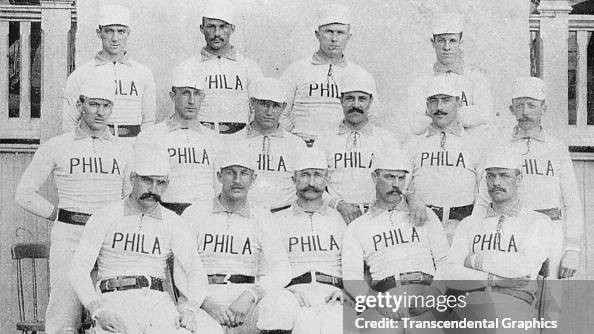
Phillies events from October 30th
- October 30, 2011 — Laynce Nix elected free agency
Outfielder Laynce Nix formally elected free agency on this date after the 2011 season, a roster move that preceded his December signing with the Phillies later that year.
Members of the Phillies born on October 30th.
- Ed Delahanty — 1867
Delahanty is a Hall of Fame outfielder who spent part of his major-league career with the Philadelphia Phillies and remains a seminal 19th-century star in franchise history. - Mark Portugal — 1962
Mark Portugal was a right-handed starting pitcher who spent part of his career with the Phillies organization during his major-league tenure. - Dave Coggin — 1977
Dave Coggin is a right-handed pitcher who spent time in affiliated baseball and was with the Phillies organization at points during his professional career. - Laynce Nix — 1980
Laynce Nix is an outfielder who played for the Philadelphia Phillies in 2012–2013 after signing with the club; he was later designated for assignment and released in August 2013.
A DEEPER DIVE… Hall of Famer Ed Delahanty
Ed Delahanty was one of baseball’s earliest superstars; a big, powerful outfielder whose name still sits high on Phillies’ all-time lists more than a century after he first arrived in Philadelphia. Born in Cleveland in 1867, he broke into professional ball in the late 1880s and was purchased by the Phillies as a young player. He had an imposing presence at the plate and a flair for dramatic hitting that made him a fan favorite wherever he played.

An extremely short-lived but influential major league that operated for a single season in 1890. It was launched by the Brotherhood of Professional Base Ball Players, led by John Montgomery Ward, as a player-driven response to the National League’s reserve clause and salary restrictions. The PL attracted many of the best players of the day and put teams in big cities, offering revenue-sharing and more player control. Despite fairly strong attendance in some markets, the league suffered from undercapitalized ownership and fierce opposition from established clubs, so it folded after one year. Its existence forced owners to rethink labor relations and left a lasting mark on pro baseball.
Delahanty’s years in Philadelphia are where he built his reputation. He first joined the Phillies in 1888 and, after a brief jump to the Players’ League, returned to Philadelphia and established himself as the offensive anchor of a potent lineup in the 1890s. The Phillies of that era featured several Hall of Famers alongside Delahanty, and the team’s outfield became legendary for its run-producing ability. Delahanty thrived in that environment, routinely posting batting averages and extra-base hit totals that put him among the era’s elite hitters.
Statistically, Delahanty was extraordinary. He won batting titles, hit better than .400 multiple times, and led the National League in numerous offensive categories over the course of his Philadelphia tenure. One of the most famous single-game feats in franchise history belongs to Delahanty: in 1896 he became the first Phillies player to hit four home runs in a game, a display of raw power that was rare in baseball’s dead-ball era and helped cement his legend among Philadelphia fans. Over his Phillies career he piled up doubles and triples at a rate that still stands among the team leaders today.
Delahanty’s style mixed grace and brute force. He combined crisp contact with an ability to drive the ball into the gaps, turning hits into doubles and triples with regularity. Contemporary accounts describe him as a flamboyant, charismatic player who drew crowds and headlines. He played the game with an intensity that could be infectious, and he was often the focal point of opposing pitchers’ strategies because of how dangerous he was in the lineup.
Off the field, Delahanty’s life had the rough edges common to many ballplayers of his time. He came from an Irish-Catholic working-class background in Cleveland and was the eldest of several brothers who would also pursue professional baseball. His personal life included the drinking and hard living that were typical of the period’s traveling ballplayers, and those habits would later play into the tragic end of his life.
After more than a decade wearing a Philadelphia uniform, Delahanty left an indelible mark on the franchise. He appears in the Phillies’ record book in a remarkable number of categories and remains one of the team’s greatest 19th-century hitters. His place in baseball history was eventually acknowledged by the Hall of Fame, and the Phillies have honored his legacy among the club’s earliest luminaries.
The end of Delahanty’s life was sudden and mysterious. In the summer of 1903, while still an active major leaguer, he died after falling from a train near Niagara Falls. Accounts vary about whether he fell accidentally or under other circumstances. The bizarre nature of his death stunned the baseball world and left a lasting, tragic coda to a brilliant career. His unexpected passing at age 35 added to the mythology that surrounds him, and stories about his final hours have been retold and debated ever since.
For Phillies fans who study the franchise’s deep history, the name Ed Delahanty is synonymous with power hitting in the game’s formative years. He helped define an era of Philadelphia baseball and set standards in the record book that modern players still aim to reach. His combination of talent, theatrics, and an untimely end keeps Ed Delahanty a compelling figure in the long, complicated story of the Phillies and of early Major League Baseball.

 Philly Baseball News