
Some presidential/World Series trivia for you: Which president was in attendance for Don Larsen‘s perfect game? The answer is found in our Deeper Dive.
Historic Phillies Events on October 9
- 1915: President Woodrow Wilson attended Game 2 of the World Series at the Baker Bowl, becoming the first sitting U.S. president to attend a World Series game. The Phillies lost 2–1 to the Red Sox.
- 1976: The Phillies dropped Game 2 of the NLCS to the Cincinnati Reds, 6–3, at Veterans Stadium.
- 1981: In a Division Series matchup, the Phillies beat the Montreal Expos 6–2 at home.
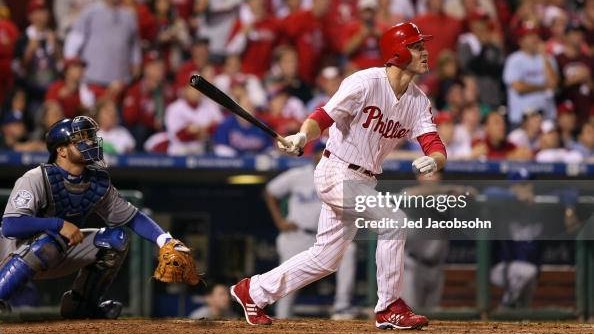
- 2008: In Game 1 of the NLCS, the Phillies edged the Dodgers 3–2 at Citizens Bank Park. Cole Hamels pitched seven strong innings, Chase Utley hit a two-run homer, and Brad Lidge closed it out for the save.
Phillies Birthdays on October 9
- Jason Pridie (born October 9, 1983) – An outfielder who played briefly for the Phillies in 2012. He appeared in 19 games, hit .370, and provided a spark during a transitional season.
- David Phelps (born October 9, 1986) – A veteran right-handed reliever who joined the Phillies during the shortened 2020 season. Though his stint was brief, he brought experience from a decade-long MLB career.
A Deeper Dive… Presidents at World Series Games
Presidential appearances at the World Series have long symbolized the intersection of sports and politics, with the commander-in-chief stepping into the role of fan-in-chief. The tradition began with President William Howard Taft, who in 1910 threw out the ceremonial first pitch at a regular season game, launching a custom that would extend to postseason play. While Taft didn’t attend a World Series game himself, his gesture laid the groundwork for future presidents to embrace baseball’s grandest moments.
President Woodrow Wilson was the first sitting president to attend a World Series game. In 1915, he watched the Philadelphia Phillies face the Boston Red Sox, marking a milestone in presidential sports engagement. Wilson’s presence at the ballpark was more than ceremonial—it was a public affirmation of baseball’s role in American life during a time of growing international tension. His attendance helped solidify the World Series as a national event worthy of presidential attention.
Calvin Coolidge followed suit in 1924, attending Game 1 of the World Series between the Washington Senators and the New York Giants. Coolidge’s appearance was notable not only because it was the first time a president watched a World Series game in Washington, D.C., but also because the Senators won the championship that year, their only title before relocating decades later. Coolidge’s quiet demeanor contrasted with the roaring crowd, yet his presence reinforced the idea that baseball was a unifying force in American culture.
Franklin D. Roosevelt, a lifelong baseball fan, attended multiple World Series games during his presidency. His most memorable appearance came in 1936 when he threw out the first pitch before Game 3 between the New York Yankees and the New York Giants. Roosevelt’s attendance during the Great Depression and his decision to keep baseball going during World War II underscored his belief in the sport’s morale-boosting power. FDR’s connection to baseball was deeply personal and political, reflecting his understanding of the game’s symbolic value.
Dwight D. Eisenhower, who played baseball at West Point, brought his love of the sport to the presidency. He attended the 1956 World Series between the Yankees and the Brooklyn Dodgers, witnessing Don Larsen’s perfect game in Game 5. Eisenhower’s presence at such a historic moment added presidential gravitas to an already legendary performance. His attendance also highlighted the growing media coverage of the World Series, as television brought the spectacle into living rooms across the country.
George W. Bush, made one of the most iconic presidential appearances in baseball history. In October 2001, just weeks after the September 11 attacks, President Bush threw out the first pitch before Game 3 of the World Series at Yankee Stadium. Wearing a bulletproof vest and a Yankees jacket, he delivered a perfect strike, a moment that resonated far beyond sports. It was a powerful symbol of resilience and unity, and it remains one of the most memorable presidential moments in World Series history.

 Philly Baseball News