
Phillies Historical Events on October 3
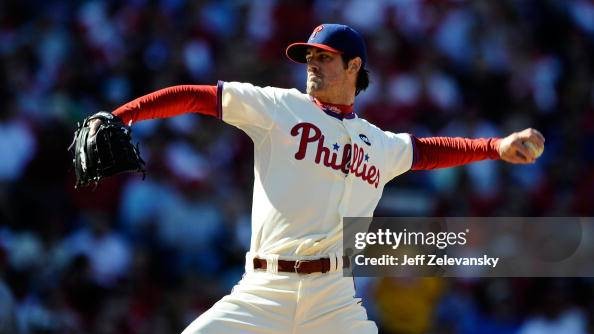
- 2007 NLDS Game 1 vs. Rockies: Cole Hamels made his postseason debut, pitching 6.2 innings with 7 strikeouts. Despite his solid outing, the Phillies lost 4–2 as Colorado’s early offensive burst proved decisive.
- 1981 Regular Season Finale: The Phillies lost to the Expos 3–0, ending a strike-shortened season. Steve Carlton pitched but took the loss, and the team missed the playoffs in a turbulent year.
- 2011 NLDS Game 1 vs. Cardinals: Roy Halladay pitched brilliantly, allowing just one run over eight innings. The Phillies won 11–6, powered by Ryan Howard’s three-run homer.
- 2023 Wild Card Clinch: The Phillies secured a postseason berth with a win over the Pirates, setting up a Wild Card matchup. The game marked a turning point in their late-season surge.
Phillies Birthdays – October 3
- Phil Gosselin (born 1988) – Gosselin played for seven different MLB teams over a 10-year career. He was with the Phillies in 2018 and 2019 and played in 83 games.
- Manny Martinez (born 1970) – Martinez made his MLB debut in 1996 with the Seattle Mariners and was placed on waivers a month after his debut. He was claimed by the Phillies and spent the rest of the season in Philadelphia. He went on to play with Pittsburgh and Montreal.
- Darrin Fletcher (born 1966) – A left-handed hitting catcher, Fletcher spent all or part of 14 seasons in the majors. He played with the Phillies in 1990 and 1991 and then played for the Dodgers, Blue Jays, and Expos.
- Rich Surhoff (born 1962) – A right-handed pitcher who pitched in just nine games, all of them in 1985. Two of those games were with the Phillies and he pitched a total of just one inning, allowing two hits, but no runs. He then pitched in 7 games for Texas with a 7.56 ERA.
A Deeper Dive on Cole Hamels in the postseason
Cole Hamels built a reputation as one of the most clutch postseason pitchers in Phillies history, with his 2008 playoff run standing as one of the most dominant in franchise lore.
Hamels made his postseason debut in 2007, starting Game 1 of the National League Division Series against the Colorado Rockies. Though he allowed just three runs over 6.2 innings, the Phillies lost the game and were swept in the series. That brief taste of October set the stage for what would become a legendary performance the following year.
In 2008, Hamels emerged as the ace of a Phillies rotation that powered the team to its first World Series title since 1980. He started five games across three rounds of the postseason and the Phillies won all five. Hamels posted a perfect 4-0 record with a 1.80 ERA, striking out 30 batters in 35 innings. Opponents hit just .190 against him. He was named the Most Valuable Player of both the National League Championship Series and the World Series. In the NLCS against the Dodgers, Hamels went 2-0 with a 1.93 ERA, including a pivotal Game 1 win that set the tone for the series. In the World Series against Tampa Bay, he started Game 1 and Game 5, allowing just four earned runs across 13 innings. His Game 5 start was interrupted by rain and ultimately concluded two days later, but Hamels had done enough to earn the win and secure the MVP award.
The 2009 postseason was a different story. Hamels struggled throughout October, finishing with a 1-2 record and a 7.58 ERA in four appearances. The Phillies reached the World Series again, this time facing the Yankees, but Hamels was unable to replicate his previous year’s dominance. His postseason ended with a disappointing outing in Game 3 of the World Series, where he allowed five runs in 4.1 innings. After the game, he made headlines by saying he couldn’t wait for the season to be over—a comment that drew criticism and marked a turning point in his postseason reputation.
Hamels rebounded in later years, delivering solid performances in the 2010 and 2011 playoffs. In 2010, he threw a complete-game shutout against the Reds in Game 3 of the NLDS, clinching the series for Philadelphia. In 2011, he pitched well in two starts against the Cardinals, allowing just three earned runs over 12 innings, though the Phillies were eliminated in five games.
Over his Phillies postseason career, Hamels appeared in 13 games, posting a 7-4 record with a 3.09 ERA. His ability to rise to the occasion in 2008 remains a defining chapter in team history. Few pitchers have matched his combination of poise, command, and effectiveness under playoff pressure. His October legacy is cemented not just by the hardware he earned, but by the confidence he inspired every time he took the mound in a big game.

 Philly Baseball News