
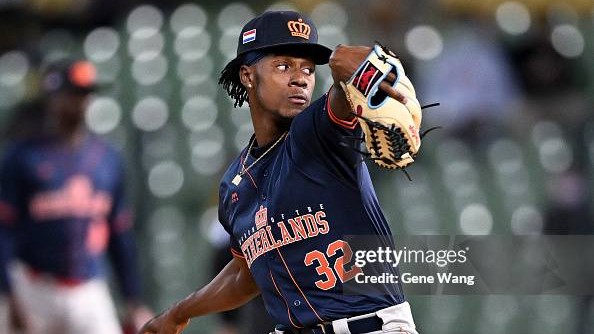
The Arizona Fall League begins next week and the Phillies have eight players on the roster of the Surprise Saguaros. Between now and the AFL Opening Day, we’ll take a look at each of those players. First up is right-hander Jaydenn Estanista.
Estanista is a high-upside right-handed pitcher in the Phillies organization whose fastball-driven arsenal and physical projection make him one of the more intriguing developmental arms in the system. While his secondary pitches are still maturing, his raw tools and flashes of dominance suggest a potential late-inning weapon or multi-inning reliever if refinement continues.
Estanista, a native of Curaçao, signed with the Phillies in November 2019 for just $10,000, a modest investment that has already yielded promising returns. Standing 6-foot-3 and weighing 180 pounds, he possesses the kind of long, lean frame that scouts dream on. His delivery is high-slot and loose, allowing him to generate natural cut and carry on his fastball. That pitch is the centerpiece of his repertoire and the reason he’s been able to climb steadily through the minor league ranks.
The fastball grades out at a 60 on the scouting scale and routinely sits in the 94–96 mph range, with reports of it touching 97. What makes it particularly effective is the combination of vertical ride and natural cut, a product of his arm slot and extension. Estanista’s fastball doesn’t just overpower hitters—it moves late and subtly, often inducing weak contact or swings under the ball. His whiff rate on the pitch is well above average, and it’s the foundation of his strikeout success. In 2024, across 53.2 innings, he struck out 71 batters, good for a 33.6% strikeout rate, placing him in the 83rd percentile among minor league pitchers.
Complementing the fastball is a developing cutter that sits in the upper 80s. This pitch is relatively new to his arsenal but has quickly become his most promising secondary weapon. It’s tight, with late depth, and functions as a bridge between his fastball and slider. Estanista uses the cutter effectively against left-handed hitters, jamming them inside or inducing soft contact off the end of the bat. While it doesn’t have elite movement, its velocity differential and command make it a useful tool, especially in short bursts.
His slider, graded at 45, is still a work in progress. It’s thrown in the low 80s and has some sweep, but lacks consistent shape and bite. Estanista has shown flashes of feel for spin, but the pitch often backs up or flattens out, making it hittable when left in the zone. That said, when he’s able to get on top of it and finish through the pitch, it can be a legitimate chase offering. The Phillies have encouraged him to continue refining the grip and release point, and there’s optimism that with more reps, the slider could become a reliable weapon against right-handed hitters.
His changeup, currently graded at 40, is the least developed of his four-pitch mix. It’s thrown in the mid-80s and lacks separation from his fastball, both in velocity and movement. Estanista has struggled to command it consistently, often missing arm-side and up. Without significant fade or drop, it’s not yet a viable option to neutralize lefties. However, given his arm speed and athleticism, there’s room for growth. The organization views the changeup as a long-term project, something that could elevate his ceiling if it ever clicks.
From a control standpoint, Estanista is still refining his command. His walk rate in 2025 sits at 16%, which is well above the desired threshold for a pitcher in his role. He occasionally struggles to repeat his mechanics, especially when fatigued, leading to bouts of wildness. His control grade of 45 reflects this inconsistency. However, he’s shown stretches of improved command, particularly in shorter outings, suggesting that a bullpen role may help mitigate some of these issues.
Statistically, Estanista’s performance has been uneven but encouraging. His 2025 season across High-A and Double-A saw him post a combined ERA of 4.84 over 44.2 innings, with 47 strikeouts and 30 walks. While the ERA and WHIP (1.43) suggest volatility, his underlying metrics paint a more nuanced picture. His expected batting average (xBA) of .161 and expected slugging (xSLG) of .284 indicate that when he’s in the zone, hitters struggle to square him up. His hard-hit rate of 29.2% and barrel rate of 9.2% are both respectable, especially for a pitcher still learning to harness his stuff.
One of Estanista’s strengths is his ability to miss bats. His whiff rate of 34.9% and swinging strike rate of 15.4% are elite for his level, underscoring the deception and life on his fastball. He’s particularly effective when ahead in the count, able to elevate the heater or back-foot the cutter to finish hitters. His chase rate of 28.75% suggests that he can get hitters to expand the zone, though he’ll need to improve his zone command to fully capitalize on this trait.
On the flip side, his biggest weakness remains consistency. Estanista has yet to show sustained success over longer outings, and his splits suggest diminished effectiveness when facing hitters multiple times. His ground ball rate is modest, and he’s prone to fly balls, which could be problematic in hitter-friendly environments. Additionally, his walk rate and occasional loss of feel for his secondary pitches make him vulnerable to big innings.
In terms of projection, Estanista profiles best as a multi-inning reliever or high-leverage bullpen arm. His fastball-cutter combination gives him a strong foundation, and if the slider or changeup take a step forward, he could become a legitimate late-inning option. The Phillies have been deliberate in his development, gradually increasing his workload and exposing him to higher levels of competition. His ETA is projected for late 2026, and he’ll likely begin the next season in Double-A with a chance to move quickly if his command improves.
The Bottom Line… Jaydenn Estanista is a high-ceiling arm with a fastball that can dominate and a cutter that adds dimension to his attack. While his secondary pitches and control remain inconsistent, the raw ingredients are present for a meaningful major league role. Continued refinement and experience will determine whether he becomes a bullpen fixture or a tantalizing what-if. Either way, he’s a name worth tracking in the Phillies’ system.

 Philly Baseball News