
A look back at the first Phillies pennant, Dick Allen, and The Bull! Plus, a pair of broadcasters were born on this date in Phillies history.
Phillies Historical Events on September 29
September 29, 1915 – First Pennant in Franchise History
The Phillies clinched their first National League pennant with a 5–0 win over the Boston Braves. Grover Cleveland Alexander threw a one-hitter, his fifth of the season, capping a dominant year and marking a milestone for the franchise.
September 29, 1968 – Dick Allen’s Three-Homer Game
Dick Allen hit three home runs, including a grand slam, in a 10–3 victory over the New York Mets. It was one of the most explosive single-game performances in Phillies history.
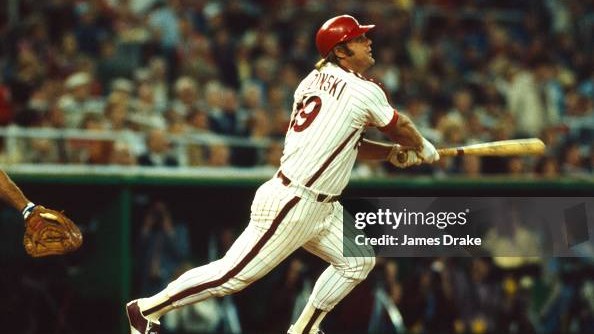
September 29, 1977 – Greg Luzinski Hits Milestone
Greg Luzinski became the youngest Phillie to reach 150 career home runs at age 26. He would go on to hit 223 homers for the team and win the Roberto Clemente Award the following year.
September 29, 2023 – Phillies Clinch Wild Card Spot
The Phillies secured a postseason berth with a win over the Pirates, continuing their late-season surge and setting the stage for another October run.
Phillies Birthdays on September 29
Dick Sisler (Born 1917)
Outfielder and first baseman best known for his dramatic three-run homer on the final day of the 1950 season that clinched the pennant. Later served as a coach and manager.
Mike Ryan (Born 1941)
Defensive-minded catcher for the Phillies from 1968 to 1973. He later became a long-time bullpen coach and was part of the 1980 World Series championship staff.
Rafael Marchán (Born 1999)
Young catcher who debuted in 2020. Known for his defensive skills and surprising pop at the plate, including a memorable first career home run in his debut season.
Tom McCarthy (Born 1968)
Television play-by-play voice of the Phillies since 2008. His energetic style and deep knowledge have made him a fan favorite.
Scott Franzke (Born 1972)
Radio play-by-play announcer since 2006. His dramatic calls during the 2008 and 2022 playoff runs are especially beloved by fans.
A deeper dive…
The 1915 Philadelphia Phillies marked a watershed moment in franchise history, capturing their first National League pennant and earning a place in the World Series. Managed by Pat Moran in his debut season, the team finished with a 90–62 record, riding a wave of dominant pitching, timely hitting, and steady leadership.
Pat Moran, a former catcher, brought a calm, strategic approach to the dugout. He emphasized fundamentals and leaned heavily on his ace, Grover Cleveland Alexander, who delivered one of the greatest pitching seasons in baseball history. Alexander won the pitching Triple Crown, leading the league in wins (31), ERA (1.22), and strikeouts (241). He also threw 12 shutouts, including a one-hitter on September 29 to clinch the pennant. His brilliance gave the Phillies a chance to win every time he took the mound.
Offensively, the team was anchored by outfielder Gavvy Cravath, who led the National League in home runs (24), RBI (115), and slugging percentage (.510). Cravath’s power was especially notable in the dead-ball era, and he took full advantage of the short right-field porch at Baker Bowl. His ability to drive in runs made him the perfect complement to Alexander’s dominance on the mound.
Supporting Cravath were steady contributors like Fred Luderus, the team’s first baseman, who hit .315 and drove in 86 runs. Luderus was also the only Phillie to homer in the 1915 World Series. Possessing a quiet consistency, he was a key figure in the lineup and a reliable glove in the field. Shortstop Dave Bancroft, though still early in his career, showed flashes of the defensive brilliance that would later earn him a spot in the Hall of Fame.
The Phillies’ outfield featured Dode Paskert and Possum Whitted, both of whom brought speed and versatility. Paskert was known for his range and base-stealing ability, while Whitted, acquired midseason, added depth and energy. Behind the plate, catcher Ed Burns handled the pitching staff with poise, helping guide Alexander and the rest of the rotation through a grueling campaign.
Philadelphia’s pitching staff beyond Alexander included Erskine Mayer (21 wins) and Al Demaree (14 wins), both of whom provided crucial support. Moran’s ability to manage workloads and matchups kept the staff fresh and effective throughout the season.
The 1915 Phillies faced the Boston Red Sox in the World Series, a club featuring a young Babe Ruth, who did not pitch in the series. Philadelphia won Game 1 behind Alexander but dropped the next four in tightly contested matchups. Despite the loss, the season was a triumph, establishing the Phillies as a legitimate contender and giving fans their first taste of postseason baseball.
Though the team would not return to the World Series until 1950, the 1915 squad remains a foundational chapter in Phillies lore – a blend of pitching brilliance, emerging power, and managerial savvy that set the tone for future generations.

 Philly Baseball News