
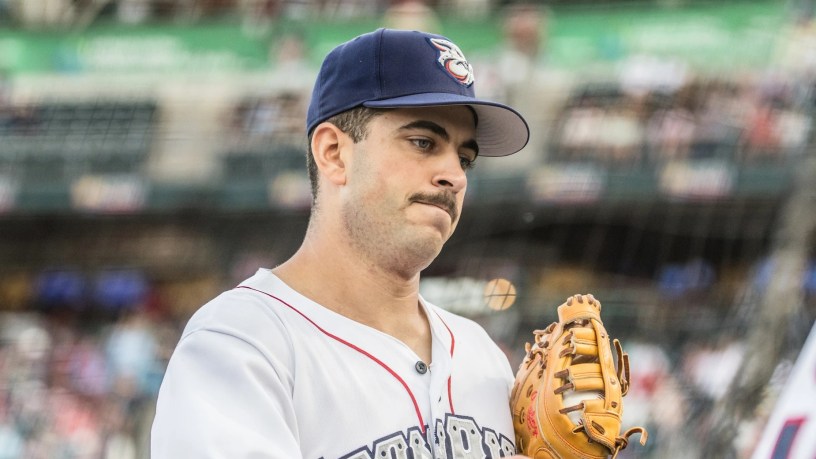
If you are a minor league player in the Phillies organization, the highest honor you can receive from the team is to be named a winner of the Paul Owens Award. In 1986, the Phillies began the award to honor the memory of Paul Owens, who spent 48 years in the Phillies organization prior to passing away in December, 2003. The award goes out annually to the top player and pitcher in the organization.
Last season, Justin Crawford and Eiberson Castellano won the award. Crawford spent the 2025 season with Triple-A Lehigh Valley while Castellano was with Double-A Reading. This season, the honor goes to Otto Kemp as the Player of the Year and Griff McGarry as the Pitcher of the Year.
Otto Kemp
Otto Kemp’s 2025 season was a tale of two levels; a breakout campaign in Triple-A that earned him the Paul Owens Award, and a learning experience in the majors that exposed both his promise and his growing pains.
Kemp began the year with the Lehigh Valley IronPigs and quickly became one of the most productive hitters in the International League. In his first 58 games, he led the league in home runs (14), runs scored (49), total bases (133), RBI (55), extra-base hits (34), slugging percentage (.594), and OPS (1.010). He was named IL Player of the Month for April and earned multiple weekly honors. His slash line over 74 total Triple-A games was .310/.417/.570 with 16 homers, 67 RBI, 64 runs, and 13 stolen bases. He also set franchise records for being hit by pitches — 19 times in the season, including four in a single game.
The Phillies called him up on June 7, and Kemp made his MLB debut that day. With injuries to Bryce Harper and Alec Bohm, he found himself thrust into regular action. Over 46 games, Kemp hit .228 with a .657 OPS and four home runs. While his plate discipline and approach were praised, the power that defined his Triple-A success didn’t translate. He began pressing for extra-base hits, expanding his zone and chasing pitches he couldn’t handle. Defensively, Kemp was versatile but inconsistent. He played first base and left field capably, but struggled at third base, committing five errors in 46 chances. The speed of the major league game caught up to him, and he admitted that the pace and pressure affected his performance.
After Harper and Bohm returned, Kemp was optioned back to Lehigh Valley on August 17. Rather than sulk, he responded with renewed focus. In his first six games back, he hit .387 with a 1.003 OPS and four doubles, including a walk-off hit. His manager, Anthony Contreras, noted Kemp’s maturity and willingness to learn from failure, emphasizing that Kemp now sees the big leagues as “just another baseball game with better talent.”
From a scouting perspective, Kemp is a right-handed hitter with a compact swing and strong plate discipline. He’s aggressive early in counts but doesn’t chase often in the minors. His bat speed and barrel control allow him to drive pitches to all fields, and he’s shown sneaky power despite a modest frame. Defensively, he’s a utility option — capable at first and left field, but needs refinement at third base. His arm is average, and his footwork can be rushed under pressure. On the bases, he’s instinctive and opportunistic, with above-average speed and good reads.
Kemp’s intangibles — work ethic, adaptability, and resilience — are what make him intriguing. As an undrafted free agent out of Division II Point Loma Nazarene, he’s already defied expectations. His 2025 season proved he can produce at the highest levels of the minors and survive in the majors. With continued development, especially defensively and in pitch selection, Kemp could carve out a role as a valuable bench piece or even a platoon starter. He’s not a top prospect, but he’s a gamer, and that counts for a lot.
Griff McGarry
Griff McGarry’s 2025 season was a roller coaster of redemption, setbacks, and flashes of brilliance — a year that rekindled hope for a once-promising Phillies pitching prospect whose career had drifted off track.
McGarry began the year in Double-A Reading, a level he hadn’t pitched at since 2023. After two years of command issues and a failed bullpen experiment at Triple-A in 2024, the Phillies returned him to a starting role and gave him a clean slate. He responded immediately. In his season debut, McGarry tossed four perfect innings with eight strikeouts, earning Eastern League Pitcher of the Week honors. Over his first three starts, he allowed just two hits and two unearned runs across 12 innings, striking out 16. However, the old nemesis — control — still lingered, as he issued seven walks in that span.
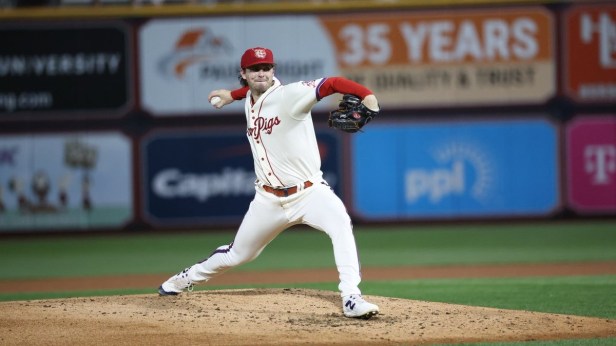
Just as momentum was building, McGarry landed on the injured list in late April. He missed about a month and made three rehab appearances in Clearwater before returning to Reading. Post-injury, his results were mixed, but August brought a resurgence. In back-to-back starts, he struck out 23 batters over 11 innings while walking just one. One outing featured six shutout innings with 12 strikeouts; the other, five innings with 11 punch-outs and only two hits allowed. These performances marked a turning point — not just in dominance, but in command, which had long been his Achilles’ heel.
McGarry made one start at Triple-A in the final week of the season and made the most of it: 5 IP, 1 H, 1 ER, 2 BB, 8 K, 89 pitches / 59 strikes.
Despite the success in Double-A, McGarry’s track record at higher levels remains troubling. In 43 career Triple-A innings, he owns a 9.21 ERA and a 2.26 WHIP, with a walk rate over 12 per nine innings. His 2024 stint as a reliever in Lehigh Valley was particularly rough: 36 walks in 30.2 innings, despite a solid strikeout rate. The Phillies’ decision to move him back to starting in 2025 was a gamble — one that, at least in Double-A, paid off.
From a scouting standpoint, McGarry remains one of the most electric arms in the system. His fastball sits in the mid-to-upper 90s with late life, and his slider is a legitimate swing-and-miss weapon, graded as plus. He also mixes in a curveball and changeup, both of which flash average but lack consistency. His delivery is high-effort and somewhat violent, contributing to his control issues. At 6-foot-2 and 190 pounds, he has the physical tools to handle a starter’s workload, but his command and mental approach have been barriers.
McGarry’s biggest challenge is throwing strikes. His career walk rate has hovered near double digits, and even in his best outings, control can vanish without warning. That said, his recent stretch — particularly the 23 strikeouts and one walk over 11 innings — suggests progress. If he can sustain that level of command, he could re-enter the conversation as a future big-league contributor, either as a starter or high-leverage reliever.
At 26, McGarry is older than most Double-A competition, and time is no longer on his side. But his 2025 season showed that the arm talent is still there. If the command holds, he could be one of the Phillies’ most surprising comeback stories. If not, he’ll remain a cautionary tale of electric stuff undone by erratic control.

 Philly Baseball News