
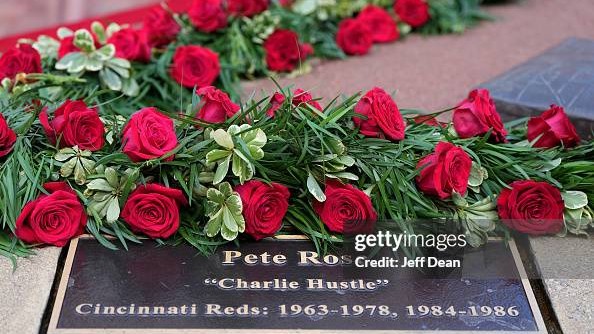
The English language is tricky. Permanent generally is taken to mean unending, forever, not ending. Commissioner Rob Manfred has placed an official limit on permanent though by stating that players who wind up on baseball’s permanently ineligible list for going afoul of Major League Baseball’s official rules can be reinstated when they pass away. As far as continuing their playing or managing careers, that is pretty permanent. In Hall of Fame terms though, it makes permanent possible, just not at a time that they can enjoy the honor of an induction ceremony.
Pete Rose, Shoeless Joe Jackson and others who were on the permanently ineligible list that kept them from induction to the Baseball Hall of Fame are now eligible because of the new ruling. For Rose, the saga concludes over 30 years of debate on whether he should at least be allowed to be considered for the Hall of Fame. It does not guarantee him an induction, however. In 1991, a rule change took away Hall of Fame eligibility from anyone on baseball’s permanently ineligible list, which in Rose’s case meant that baseball’s all-time hit king would never be inducted. The new ruling means that he could be elected to the Hall of Fame.
The latest round of work on Rose’s behalf started with his longtime lawyer Jeffrey Lankov and his daughter Fawn met with Manfred three months after Rose’s death in September from a heart condition. Following that meeting, they officially petitioned MLB to reinstate Rose so that he could be considered for the Hall of Fame posthumously. The matter actually reached an even higher level when Manfred was invited to the White House to speak with President Trump, who later tweeted that Rose should be allowed into the Hall of Fame.
In an interview with John Condit, a Dayton, Ohio sportscaster, less than two weeks prior to his death from a heart condition, Rose gave what turned out to be an auspicious quote: “I’ve come to the conclusion – I hope I’m wrong – that I’ll make the Hall of Fame after I die, which I totally disagree with because the Hall of Fame is for two reasons: your fans and your family. That’s what the Hall of Fame is for; your fans and your family. And it’s for your family if you’re here. It’s for your fans if you’re here. Not if you’re 10 feet under.”
In all, there were 16 other individuals on the permanently ineligible list besides Rose, who have passed away. Most of them were connected to the 1919 Black Sox scandal with “Shoeless” Joe Jackson being the most prominent. Others who were caught in the scheme to throw the 1919 World Series and were banned include: Eddie Cicotte, Happy Felsch, Joe Gedeon, Chick Gandil, Lee Magee, Fred McMullin, Gene Paulette, Swede Risberg, Buck Weaver, and Lefty Williams.
Others who were banned, but not a part of the Black Sox scandal are:
Benny Kauff – Kauff, along with his brother, was accused of stealing a car, repainting it, and selling it in December of 1919. He denied the charges and was acquitted by a jury, but was still banned by baseball.
Phil Douglas – Giants manager John McGraw suspended Douglas after the two had a dispute. Douglas wrote a letter to a player on another team stating that he would abandon the Giants, causing them to lose games, if he were to receive money to do so.
In addition to Rose, there are three other people on the list with connections to the Phillies organization: Jimmy O’Donnell and Cozy Dolan. O’Donnell, an outfielder with the Giants, and Dolan, one of the Giants coaches, offered $500 to Phillies shortstop Heinie Sand to help throw games that would give the Giants an edge in their pursuit of the pennant in 1924. Sand not only rejected the offer, but turned the pair in. William Cox was a lumber entrepreneur who became the owner of the Phillies, but lasted less than a year in that position. Manager Bucky Harris heard Cox’s secretary talking about betting odds and asked if Cox was betting on baseball. The secretary confirmed that he was and that it was no secret. Harris later admitted that he was gambling on the team, but denied knowing it was against the rules.
What happens now?
Baseball’s Historical Overview Committee will develop a ballot of eight names to be considered by the Classic Baseball Era Committee, which evaluated players who made their greatest impact prior to 1980. Unfortunately, that committee of 16 former players, front office executives, and other baseball personnel is not scheduled to meet until December of 2027. Any player considered by that committee will need to get 12 votes to be inducted.

 Philly Baseball News